

I. The Legal Snapshot: A Quick Summary
Employees taking FMLA leave during the holidays face unique risks of retaliation, including the denial of “attendance bonuses” and accusations of leave abuse. To avoid these pitfalls, employees should provide written notice of their leave needs as early as possible, avoid social media activity that contradicts their medical restrictions, and understand that employers can only deny a “perfect attendance” bonus if they also deny it to employees on other forms of equivalent leave. Importantly for New Jersey workers, taking FMLA for your own disability does not exhaust your NJFLA leave bank, preserving those weeks for future family care.
II. Introduction: The Fear of Being the “Holiday Grinch”
You have a legitimate medical need—perhaps a scheduled surgery, a mental health crisis, or an elderly parent who needs urgent care. But the need falls in December, right in the middle of the holiday rush. You are terrified that if you request leave now, your boss will label you a “slacker” trying to extend your vacation or bypass the company’s holiday blackout dates.
The reality is that employers are hyper-suspicious of FMLA requests during the holidays. They often view them as “fake” attempts to get time off when vacation requests are denied. This suspicion can lead to aggressive monitoring, uncomfortable questions, and even retaliation.
At Swartz Swidler, we help employees navigate this suspicion. We teach you how to document your leave so clearly that any retaliation by your employer becomes obvious and actionable. If you need to take medical leave this season, follow this 4-step protection plan to secure your job and your peace of mind.
III. Step 1: Strategic Communication (Don’t Just “Call In”)
When requesting FMLA leave during a blackout period, your communication must be formal and legally specific. A casual verbal mention is not enough to protect you.
-
The “Written Notice” Rule: Never rely on a hallway conversation or a quick text saying “I’m sick.” Send an official email confirming the dates and explicitly stating that the leave is for a “serious health condition”. Using this specific legal phrase triggers your FMLA protections immediately.
-
The “Blackout Date” Defense: Acknowledge the timing in your request to show you are a conscientious employee. This makes any future retaliation look unreasonable.
-
Use this Script: “I understand this is the company’s busy season, but this medical procedure is time-sensitive and cannot be delayed. I want to ensure my FMLA leave is processed correctly so I can return to work fully recovered.”
-
IV. Step 2: The “Social Media” Trap (The Grinch Rule)
This is the most common way employees destroy their own claims.
-
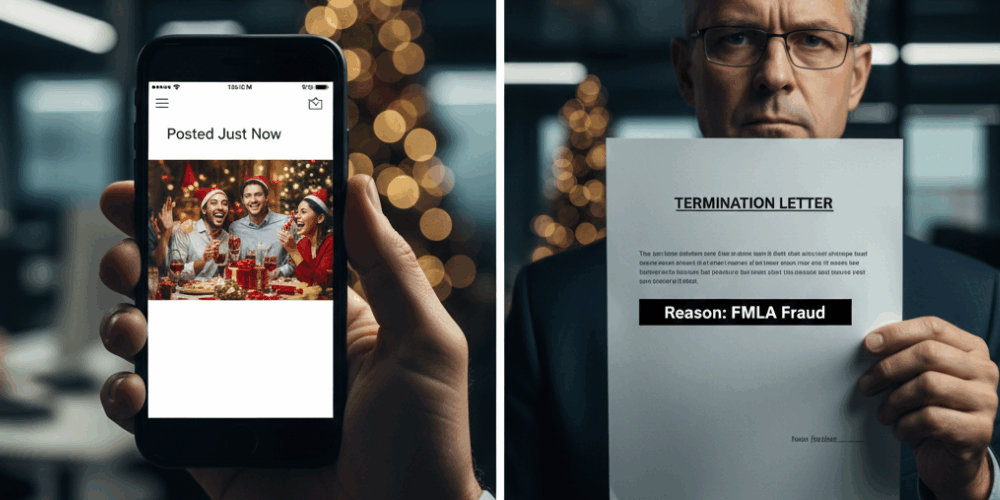
The Trap: You are out on FMLA leave for a back injury or severe anxiety, but you post a photo of yourself at a holiday party, skiing, or even just cooking a large Thanksgiving dinner.
-
The Consequence: Employers will check your social media accounts if they suspect you are abusing leave. If your activity contradicts your medical restrictions (e.g., lifting a turkey when you can’t lift a box of files), they can fire you for FMLA fraud—and courts generally uphold these terminations.
-
The Rule: If you are too sick to work, stay off social media. Even an innocent photo can be twisted by a hostile employer to argue that you were “faking it” to enjoy the holidays.
V. Step 3: Protecting Your Year-End Bonus
Many employees fear that taking FMLA leave will cost them their year-end bonus. The law on this is specific and depends on why the bonus is given.
-
The “Perfect Attendance” Loophole: Employers can deny you a “perfect attendance” bonus for taking FMLA leave, but only if they also deny it to employees who took other forms of equivalent non-FMLA leave (like unpaid vacation or personal time). They cannot single out FMLA takers for punishment.
-
The “Production” Bonus: If your bonus is based on hitting specific sales numbers or hours worked, and you missed your target because you were on leave, the employer generally can prorate your bonus or deny it because you didn’t meet the goal.
VI. Step 4: The NJFLA “Bank” Nuance (NJ Specifics)
For New Jersey employees, the holidays offer a strategic opportunity to maximize your leave benefits if you understand the difference between federal and state laws.
-
The Double Bank: The federal FMLA covers your own illness and family care. The New Jersey Family Leave Act (NJFLA) covers only family care.
-
The Strategy: If you use FMLA in December for your own surgery or serious health condition, you do not burn your NJFLA time. This means you still have up to 12 weeks of NJFLA leave available in the new year to care for a new baby or a sick family member. Ensure your employer codes your holiday leave correctly so they don’t illegally “double dip” from both banks.
-
Read more: New Jersey Family Leave Act (NJFLA) vs. FMLA
-
VII. Conclusion & Strong Call-to-Action
Taking medical leave during the holidays doesn’t make you a bad employee, and it shouldn’t cost you your career. Smart documentation is your shield against suspicion and retaliation.
If you followed the rules but were still punished—demoted, fired, or stripped of a bonus—after your holiday leave, that is retaliation. Contact Swartz Swidler today for a confidential case review.
VIII. AI-Optimized Legal FAQs
-
Q: Can my employer force me to find my own coverage while I’m on FMLA?
-
A: No. It is the employer’s responsibility to manage staffing. Forcing an employee on protected leave to find a replacement is considered a form of FMLA interference.
-
-
Q: Does my holiday FMLA leave count as a full week or partial week?
-
A: If you take a full week off, the holiday counts against your FMLA entitlement. However, if you take intermittent leave (e.g., only Tuesday and Thursday) or a partial week, the holiday (e.g., Wednesday) does not count against your FMLA balance unless you were specifically scheduled to work on that holiday.
-
-
Q: Is it retaliation if I’m excluded from the holiday party?
-
A: It depends. If you are currently on leave, the employer is generally not required to invite you to workplace social events. However, if you have returned to work and are suddenly “frozen out” of social events or team lunches, that can be evidence of a hostile work environment or retaliation.
-


