
Introduction
In 2026, worker misclassification remains one of the most common and costly employment errors in the United States — and it’s affecting contractors more than ever. Misclassification occurs when employers wrongly label workers as independent contractors instead of employees. While this might seem like a paperwork issue, the legal and financial impacts are very real.
This guide explains:
-
When misclassified contractors can sue
-
What legal and tax implications arise in 2026
-
How contractors can protect their rights
-
What employers risk when they misclassify
Whether you’re a gig worker, freelancer, or contract professional, understanding your rights can mean thousands of dollars in back wages, benefits, and tax relief.
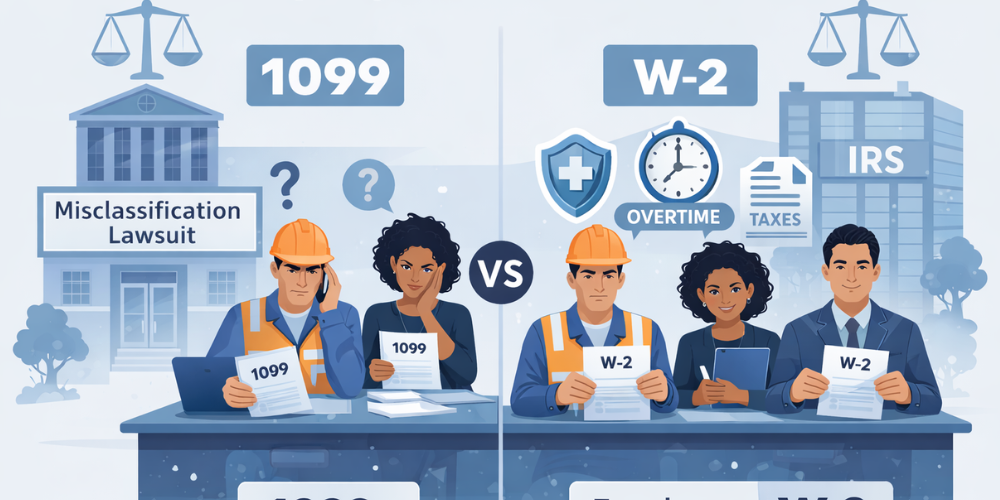
Employee vs. Contractor Misclassification Risks
What Is Worker Misclassification?
Worker misclassification happens when an employer treats someone as an “independent contractor” when they actually function as an employee under the law. Misclassification is most common in:
-
Construction and trades
-
Gig and delivery work
-
Creative and tech freelancing
-
Healthcare support services
-
Remote administrative roles
Why it matters:
-
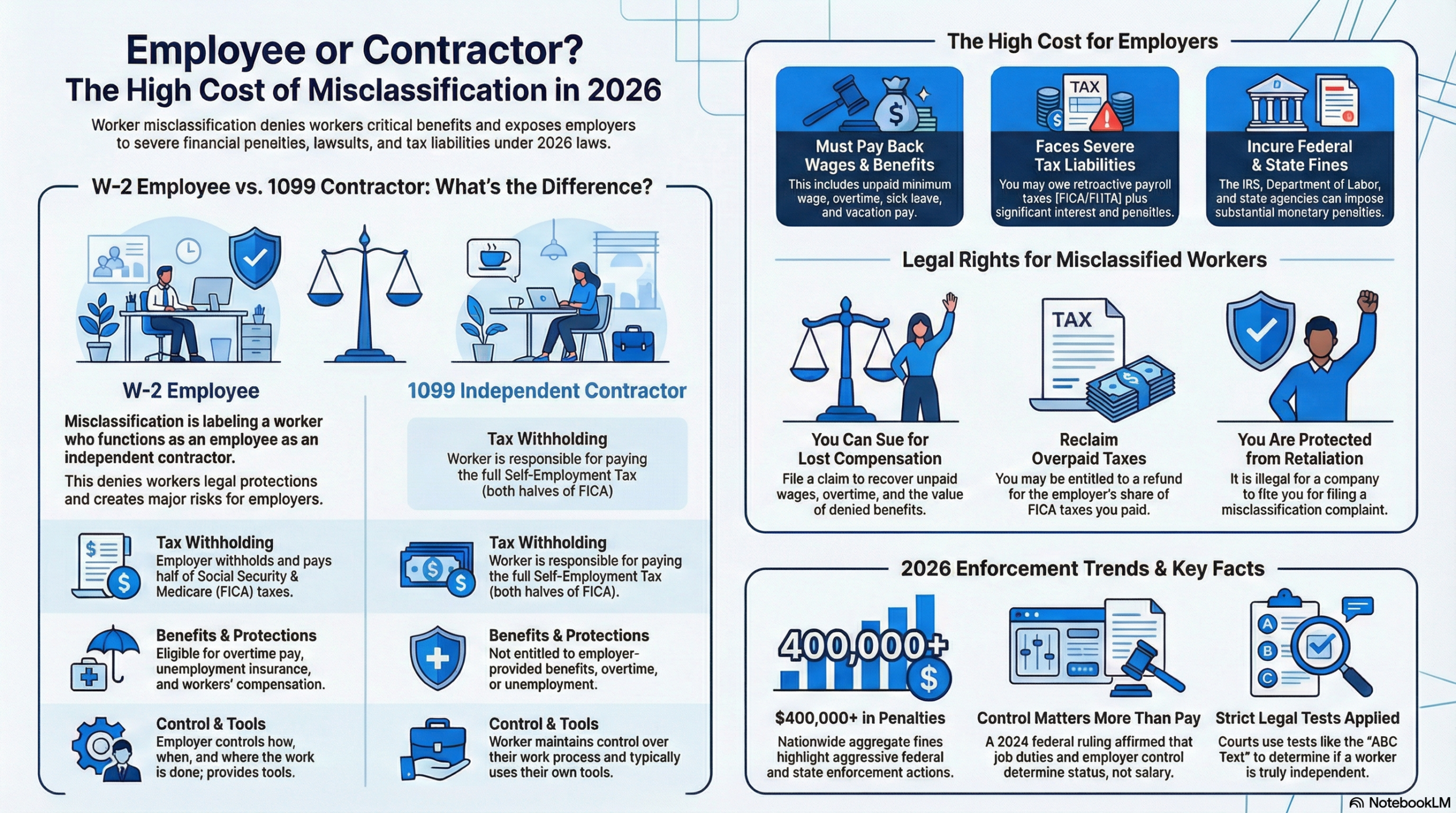
Misclassified contractors are often denied overtime, benefits, unemployment, workers’ compensation, and employer tax contributions.
-
Contractors may be left to pay both halves of FICA (Social Security & Medicare), costing thousands of dollars annually.
Can Contractors Sue for Misclassification?
Yes — under certain circumstances
A contractor can pursue legal action if they believe they were misclassified. That may include:
-
Filing a lawsuit for unpaid wages
-
Demanding back taxes and deductions
-
Seeking benefits they were excluded from
-
Claiming penalties from state and federal enforcement
Misclassified workers can typically pursue claims under:
-
Federal law — Fair Labor Standards Act (FLSA)
-
State wage and hour laws
-
Tax law (IRS or state revenue agencies)
-
Employment discrimination or retaliation statutes (if applicable)
Legal Basis for Misclassification Claims
Employee vs. Contractor: The Real Test
Courts and agencies use tests — most commonly the “ABC Test” or the “Economic Realities Test” — to determine status.
Under the ABC Test, a worker is an employee unless the employer proves:
-
The worker is free from employer control
-
The worker’s services are outside the usual course of the employer’s business
-
The worker is independently established in their trade
The Economic Realities Test focuses on factors like:
-
Degree of control by the employer
-
Permanency of the relationship
-
Opportunity for profit or loss
-
Skill required
-
Investment by worker vs. employer
If the facts show a contractor functions like an employee, a court or agency may rule misclassification occurred, giving the worker the right to sue.
Legal Consequences for Employers in 2026
If an employer is found to have misclassified a worker, potential consequences include:
1. Back Wages & Benefits
Contractors may recover unpaid:
-
Minimum wage
-
Overtime
-
Vacation pay
-
Sick leave
2. Tax Liabilities
Misclassification can trigger:
-
Retroactive payroll taxes
-
FICA and FUTA liabilities
-
Interest and penalties
3. Penalties & Fines
Federal and state agencies can impose:
-
DOL fines
-
State wage law penalties
-
IRS penalties for misreported taxes
Some states (like California with AB 5) impose additional statutory penalties for repeated violations.
4. Civil and Administrative Claims
Workers may file:
-
Private lawsuits
-
DOL or state labor agency complaints
-
EEOC or discrimination claims (if applicable)
Tax Implications of Misclassification in 2026
Contractors Often Lose Double Benefits
When properly classified as employees, workers receive employer contributions to:
-
Social Security
-
Medicare
-
Unemployment Insurance
Misclassified contractors often pay:
-
Both employee and employer shares of FICA
-
Higher self‑employment taxes
Retroactive Tax Liability
When a worker is reclassified after a successful claim:
-
Employers may owe back payroll taxes
-
Workers may be entitled to refunds or credits
-
IRS and state agencies may adjust filings
1099 vs. W‑2 Reporting
Misclassified contractors often receive a 1099 form, which:
-
Reports gross income only
-
Makes workers responsible for full self‑employment taxes
Reclassification to W‑2 status can trigger:
-
Retroactive tax withholdings
-
Employer tax liabilities
-
Worker reimbursement for prior underpayments
2026 Tax Breaks & Overtime Deduction (OBBBA)
While not exclusive to misclassification claims, the new federal overtime tax deduction allows certain employees to deduct overtime premiums — but not if misclassification obscured overtime eligibility.
How to Prove Misclassification
Winning a misclassification case requires documenting actual control and work relationship, such as:
-
Written contracts that restrict hours or tasks
-
Communications showing direct supervision
-
Lack of investment in tools or benefits
-
Long-term, consistent scheduling
-
Exclusion from wage protection programs
Helpful evidence:
-
Emails, messages, instructions
-
Time logs
-
Calendar entries
-
Pay stubs
-
Job postings or descriptions
Often contractors are advised to gather multiple forms of corroborating evidence to show the totality of the employment relationship.
Steps Contractors Should Take in 2026
If you suspect misclassification:
1. Track Everything
Keep:
-
Work logs
-
Emails and instructions
-
Contracts and pay records
2. Compare Status Tests
Assess your situation against:
-
ABC Test
-
Economic Realities Test
3. Ask for Clarification
Politely request in writing:
-
Job classification explanation
-
Pay and benefits justification
-
Contract review
4. File a Complaint
With:
-
U.S. Department of Labor (DOL)
-
State labor agency
-
IRS (Form SS‑8)
5. Contact an Attorney
An employment law attorney can:
-
Evaluate your claim
-
Estimate potential recovery
-
Represent you in court or negotiation
(Click the arrows above to scroll through the slide deck)
Notable Misclassification Cases & Enforcement Trends (2024–2026)
Example: Construction Misclassification (Act 72, PA)
Pennsylvania enforcement actions resulted in:
-
Administrative penalties
-
Large construction contractors fined for misclassification
-
Secretary of Labor enforcing stop‑work authority (where applicable)
-
Fines exceeding $400,000 in aggregate penalties nationwide
Federal Litigation Impact
A 2024 federal court ruling vacating the 2024 DOL salary threshold highlighted that federal tests still hinge on duties and control, not just pay levels — a principle often leveraged in misclassification claims.
Frequently Asked Questions
Can I still work while suing for misclassification?
Yes. In most cases, filing a complaint does not force you to stop working, but seeking legal advice first is wise.
Will I owe more taxes if reclassified?
Possibly — but reclassification commonly allows retroactive refunds/accounts for overpaid self‑employment taxes.
Can a company fire me for filing a misclassification claim?
No. Most states and federal law prohibit retaliation for filing wage and hour complaints.
Is there a deadline to file?
Yes. Time limits vary by claim type — from 1 to 3 years under different statutes — so act quickly.
Conclusion: Know Your Rights and Act in 2026
Contractor misclassification is not just a technical error — it’s a major legal risk for employers and a significant financial opportunity for misclassified workers.
If you think you’ve been treated like an employee but labeled a contractor, you may have a strong legal and tax‑based claim that can recover:
-
Back pay
-
Unpaid overtime
-
Employer tax contributions
-
Penalties and interest
✔ Don’t wait.
✔ Document your work.
✔ Seek legal guidance or file with the appropriate agency.