
On this page
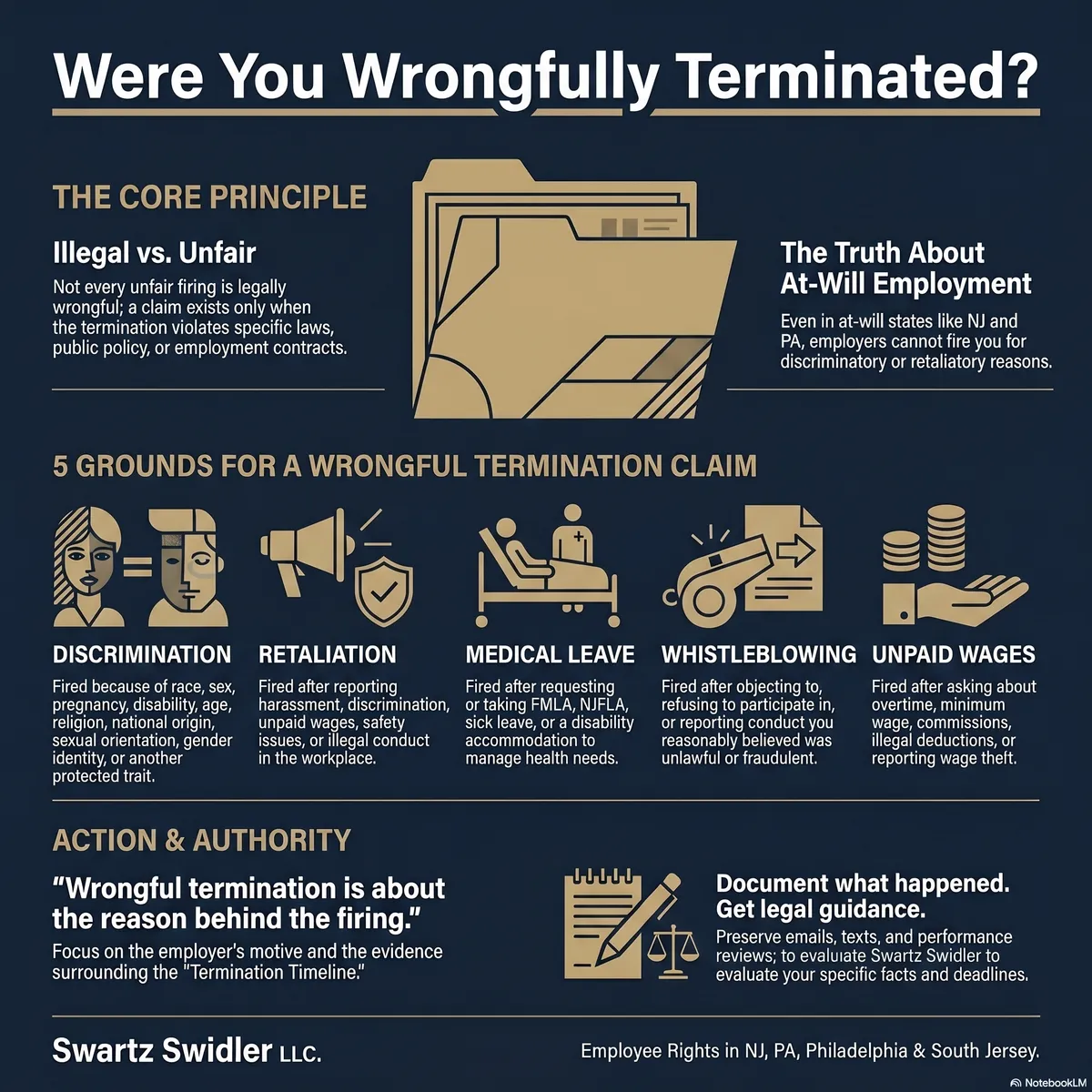
Losing your job can be stressful, confusing, and financially frightening. But not every unfair firing is legally wrongful. In New Jersey and Pennsylvania, a wrongful termination claim usually means your employer fired you for a reason the law prohibits, such as discrimination, retaliation, whistleblowing, protected medical leave, reporting harassment, complaining about unpaid wages, or refusing to participate in illegal conduct.
Swartz Swidler represents employees in New Jersey, Pennsylvania, Philadelphia, and South Jersey who believe they were fired for an unlawful reason. Our attorneys can review what happened, explain whether the facts may support a claim, and help you understand your next steps after termination.
Direct answer
Wrongful termination means an employee was fired for an illegal reason, not simply an unfair reason. You may have a wrongful termination claim if your firing was connected to discrimination, harassment complaints, retaliation, whistleblowing, protected leave, unpaid wage complaints, disability accommodations, pregnancy, sexual harassment, or another protected workplace right.
Questions about a recent termination? Call Swartz Swidler at 856.685.7420 or submit an employment law claim online.
Do I have a wrongful termination case?
You may have a wrongful termination case if you can connect your firing to an unlawful reason. The strongest cases usually involve a protected characteristic, a protected activity, suspicious timing, inconsistent employer explanations, or evidence that the employer’s stated reason is not the real reason. If your firing followed a workplace complaint, review our guide to how to prove workplace retaliation.
Wrongful Termination Red Flags and Evidence to Save
| Question | Why it matters | Examples of useful evidence |
|---|---|---|
| Were you fired after reporting discrimination, harassment, unpaid wages, safety concerns, or illegal conduct? | Termination after protected activity may support a retaliation claim. | HR complaints, emails, text messages, witness names, timeline of events. |
| Were you fired because of race, sex, disability, age, religion, pregnancy, national origin, sexual orientation, or another protected trait? | Firing based on protected status may violate federal, New Jersey, or Pennsylvania anti-discrimination laws. | Discriminatory comments, comparator evidence, discipline history, performance reviews. |
| Were you fired after medical leave, FMLA leave, NJFLA leave, or a disability accommodation request? | Termination connected to protected leave or accommodation requests may be unlawful. | Leave paperwork, doctor’s notes, accommodation requests, return-to-work emails. |
| Did your employer change its explanation for why you were fired? | Shifting explanations may suggest the stated reason is not the real reason. | Termination letter, unemployment response, HR emails, performance records. |
| Were other employees treated better for the same conduct? | Different treatment may support discrimination or retaliation claims. | Comparator names, schedules, discipline records, witness statements. |
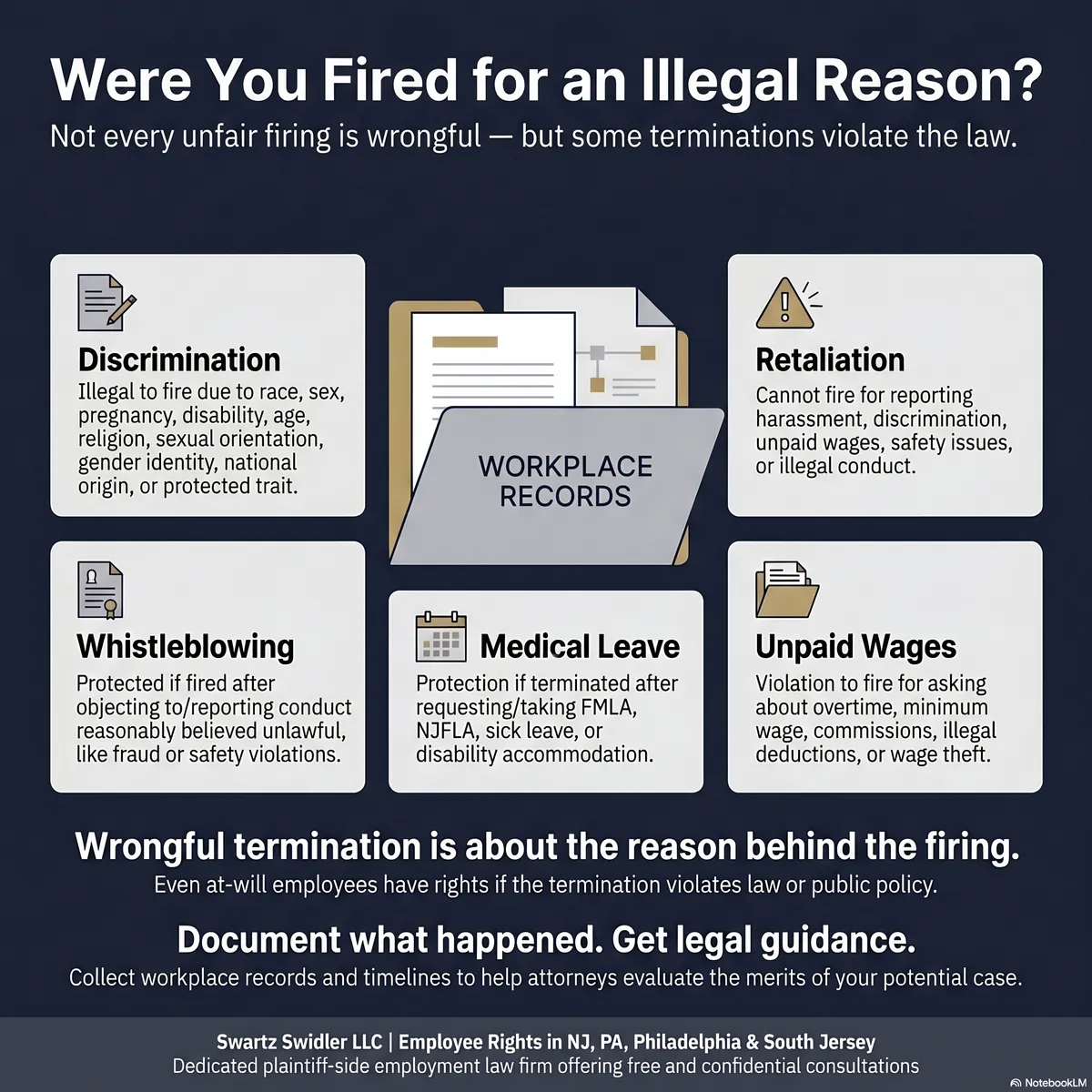
What is wrongful termination?
Wrongful termination, also called wrongful discharge, occurs when an employee is fired for a reason that violates the law, public policy, an employment contract, or certain protected workplace rights.
Wrongful termination can involve many different legal theories, including:
- discrimination based on a protected characteristic;
- retaliation for reporting discrimination or harassment;
- retaliation for whistleblowing;
- termination after protected medical or family leave;
- termination after requesting a disability accommodation;
- termination after complaining about unpaid wages, overtime, or wage theft;
- termination after reporting safety violations or illegal conduct;
- breach of an employment contract;
- termination that violates public policy; or
- constructive discharge where the employee is forced to resign because working conditions became intolerable due to unlawful conduct.
The fact that a termination feels unfair does not automatically make it illegal. The legal issue is whether the employer’s reason for firing you was prohibited by law.
At-will employment does not mean your employer can fire you for an illegal reason
Most employees in New Jersey and Pennsylvania are considered at-will employees. That generally means an employer can terminate employment with or without cause, and an employee can leave with or without cause.
But at-will employment has important limits. An employer cannot fire an employee for a discriminatory reason, a retaliatory reason, a reason that violates public policy, or a reason that violates an employment contract or statute.
Important distinction
At-will employment allows many unfair terminations, but it does not allow illegal terminations. If your firing was connected to discrimination, retaliation, whistleblowing, protected leave, wage complaints, or another protected right, you may still have a claim.
Common examples of wrongful termination
Fired after reporting discrimination or harassment
An employer should not fire an employee because the employee reported discrimination, sexual harassment, racial harassment, disability discrimination, pregnancy discrimination, or other unlawful workplace conduct. Retaliation can be a separate legal claim even if the underlying complaint is still being investigated.
Examples include being fired after reporting racial slurs, sexual comments, disability-related harassment, unequal discipline, hostile work environment, or discriminatory pay practices.
Fired because of a protected characteristic
It may be wrongful termination if an employer fires an employee because of race, color, religion, sex, pregnancy, breastfeeding, sexual orientation, gender identity or expression, national origin, ancestry, disability, age, genetic information, military service, or another protected characteristic under the applicable law.
New Jersey employees may have protections under the New Jersey Law Against Discrimination. Pennsylvania employees may have protections under the Pennsylvania Human Relations Act and federal law.
Fired after whistleblowing
Retaliation against whistleblowers may be unlawful. In New Jersey, the Conscientious Employee Protection Act, often called CEPA or the Whistleblower Act, protects many employees who disclose, object to, or refuse to participate in conduct they reasonably believe violates the law, is fraudulent, is criminal, or violates clear public policy.
Whistleblower claims can involve reports about fraud, safety violations, wage violations, patient care issues, environmental violations, misuse of public funds, billing misconduct, regulatory violations, or other unlawful practices.
Fired after FMLA, NJFLA, or medical leave
An employee may have a wrongful termination or retaliation claim if they were fired for requesting or taking protected medical or family leave. The FMLA provides eligible employees of covered employers with job-protected leave for qualifying family and medical reasons. The FMLA also prohibits interference and retaliation.
Examples include being fired shortly after requesting medical leave, being replaced while on leave, being denied restoration after leave, or being disciplined for absences that should have been protected.
Fired after asking for a disability accommodation
An employer should not fire an employee because the employee requested a reasonable accommodation for a disability. If the employer knew about your medical restrictions, refused to discuss accommodations, or terminated you instead of engaging in the accommodation process, legal review may be needed.
Fired after complaining about unpaid wages or overtime
Employees have rights to complain about unpaid wages, unpaid overtime, minimum wage violations, illegal deductions, misclassification, and other wage and hour issues. Federal and state laws may prohibit employers from firing or punishing employees because they raised wage concerns or participated in wage investigations.
If your termination happened after you complained about pay, overtime, salary classification, off-the-clock work, or wage theft, you may have both a wage claim and a retaliation claim.
Fired for refusing to do something illegal
A termination may be wrongful if an employer fires an employee for refusing to participate in illegal conduct, objecting to illegal instructions, or reporting conduct the employee reasonably believes violates the law.
Fired in violation of an employment contract
Some employees have contracts, offer letters, collective bargaining agreements, commission plans, severance agreements, or written policies that limit when or how they can be terminated. If your employer violated a written agreement, you may have a breach of contract claim in addition to other employment law claims.
What is constructive wrongful termination?
Constructive termination, also called constructive discharge, may occur when an employer does not directly fire an employee but makes working conditions so intolerable that a reasonable person would feel forced to resign.
Constructive discharge claims can be difficult and fact-specific. Employees should not assume they can quit and automatically sue. If possible, document the conditions, report the problem through appropriate channels, give the employer a chance to correct unlawful conduct, and speak with an employment lawyer before resigning.
Examples that may support constructive discharge include:
- severe harassment that the employer refuses to stop;
- retaliation after reporting discrimination or illegal activity;
- threats or intimidation after protected complaints;
- being pressured to resign because of pregnancy, disability, medical leave, age, race, sex, or another protected trait;
- being stripped of duties, isolated, or humiliated after reporting unlawful conduct; or
- working conditions that became intolerable because of unlawful discrimination or retaliation.
Thinking about quitting?
If you feel forced to resign, try to get legal guidance before quitting if you can. A resignation may affect your wrongful termination claim, unemployment benefits, severance negotiations, and available remedies.
What wrongful termination is not
Some firings are unfair, harsh, or poorly handled but not necessarily unlawful. A termination may not be wrongful if the employer fired an employee for a lawful reason, even if the decision was mistaken or unfair.
Examples that may not be wrongful by themselves include:
- being fired because of a personality conflict;
- being fired because a supervisor disliked your attitude;
- being fired for poor performance if the reason is not a pretext for discrimination or retaliation;
- being laid off for legitimate business reasons;
- being fired because of restructuring or budget cuts;
- being fired after a policy violation that was applied consistently; or
- being fired without warning, if no law, contract, or policy required warning.
That said, employers sometimes use performance, restructuring, or policy violations as cover for illegal motives. If the stated reason does not match the facts, or if the timing looks suspicious, you should preserve evidence.
Evidence that may help prove wrongful termination
Wrongful termination cases often depend on evidence showing what happened before the firing, what reason the employer gave, whether that reason changed, and whether the timing suggests discrimination or retaliation.
Documents to save after being fired
- Termination letter or separation notice
- Emails, texts, Slack messages, Teams messages, or voicemails
- HR complaints and management responses
- Performance reviews before and after any complaint
- Disciplinary write-ups
- Pay stubs, schedules, timecards, and overtime records
- Leave paperwork, FMLA forms, doctor’s notes, or accommodation requests
- Employee handbook and workplace policies
- Offer letter, employment contract, commission plan, or severance agreement
- Names of witnesses
- Evidence showing other employees were treated differently
- Unemployment documents and employer responses
- Job search records after termination
What should you do after being wrongfully terminated?
1. Write a timeline
Write down what happened while the details are fresh. Include dates of complaints, HR reports, leave requests, accommodation requests, performance reviews, discipline, threats, schedule changes, and termination.
2. Save evidence
Preserve documents lawfully. Do not delete messages. Do not rely only on a company email account or device you may lose access to.
3. Do not sign a severance agreement too quickly
A severance agreement may include a release of legal claims. Before signing, make sure you understand what rights you may be giving up.
4. File for unemployment if appropriate
If you lost your job, you may be eligible for unemployment benefits. If your employer contests your claim, evidence about why you were terminated may become important.
5. Keep job search records
If you are seeking lost wages, you may need to show that you looked for comparable work. Keep applications, emails, interview records, rejection notices, and job search notes.
6. Speak with an employment lawyer quickly
Wrongful termination claims can involve short deadlines. The deadline depends on the type of claim, the law involved, the agency, and where the claim is filed. Do not wait to get advice if you believe your termination was unlawful.
New Jersey wrongful termination claims
New Jersey employees may have wrongful termination claims under several laws, depending on the facts. These may include the New Jersey Law Against Discrimination, CEPA, New Jersey wage and hour laws, the New Jersey Family Leave Act, New Jersey earned sick leave protections, employment contracts, and federal laws such as Title VII, the ADA, the ADEA, the FMLA, and the FLSA.
Examples of New Jersey wrongful termination claims may include:
- being fired after reporting discrimination or harassment;
- being fired after requesting disability accommodations;
- being fired because of pregnancy or breastfeeding;
- being fired after taking or requesting protected family or medical leave;
- being fired after reporting wage violations or unpaid overtime;
- being fired after objecting to illegal conduct;
- being fired after whistleblowing under CEPA; or
- being forced to resign because of unlawful retaliation or harassment.
New Jersey workers may have multiple overlapping claims. For example, a termination after a medical leave request may involve disability discrimination, leave interference, retaliation, and wrongful termination.
Pennsylvania and Philadelphia wrongful termination claims
Pennsylvania is also generally an at-will employment state, but Pennsylvania employees still have legal protections against termination for unlawful reasons. A wrongful termination claim may involve federal law, the Pennsylvania Human Relations Act, wage and hour protections, whistleblower protections, contract rights, public policy exceptions, or local Philadelphia protections depending on the facts.
Examples of Pennsylvania or Philadelphia wrongful termination claims may include:
- being fired because of race, sex, disability, age, religion, national origin, ancestry, sexual orientation, gender identity, or another protected trait;
- being fired after opposing discrimination or harassment;
- being fired after taking FMLA leave;
- being fired after requesting an accommodation;
- being fired after complaining about unpaid wages or overtime;
- being fired after reporting illegal activity or safety concerns; or
- being fired in violation of an employment contract or public policy.
How Swartz Swidler can help
Wrongful termination cases are fact-specific. The reason your employer gave may not be the real reason. Swartz Swidler can help you evaluate the timeline, documents, witnesses, protected activity, employer explanations, and possible damages.
Our attorneys can help with wrongful termination matters involving:
- discrimination;
- retaliation;
- sexual harassment complaints;
- racial discrimination or racial harassment;
- disability discrimination;
- pregnancy discrimination;
- age discrimination;
- FMLA, NJFLA, medical leave, or disability accommodation issues;
- unpaid wages, overtime, and wage theft complaints;
- whistleblower retaliation;
- constructive discharge;
- severance agreement review; and
- unemployment disputes after termination.
We focus on helping employees understand what happened, what evidence matters, and what legal options may be available.
Frequently asked questions
What is wrongful termination?
Wrongful termination occurs when an employer fires an employee for a reason prohibited by law, such as discrimination, retaliation, whistleblowing, protected leave, wage complaints, or exercising workplace rights.
Can I sue if I was fired without warning?
Being fired without warning is not automatically illegal. However, you may have a claim if the firing was based on discrimination, retaliation, protected leave, whistleblowing, breach of contract, or another unlawful reason.
Can I be fired in an at-will employment state?
Yes. At-will employment generally allows employers to terminate employees for many reasons or no reason. But an employer cannot fire an employee for an illegal reason.
How do I know if my termination was retaliation?
Retaliation may exist if you were fired after protected activity, such as reporting discrimination, complaining about harassment, requesting leave or accommodations, reporting wage violations, or objecting to illegal conduct. Timing, documents, witness testimony, and shifting employer explanations may matter.
What if my employer says I was fired for poor performance?
An employer may lawfully fire an employee for poor performance. But if the performance reason is false, exaggerated, inconsistent, or only appeared after protected activity, it may be a pretext for wrongful termination.
Can I bring a wrongful termination claim if I resigned?
Possibly. If you resigned because unlawful working conditions became intolerable, you may have a constructive discharge claim. These claims are fact-specific, so legal guidance is important before or soon after resigning.
Can I be fired after filing a harassment complaint?
An employer should not fire or punish an employee for reporting harassment or discrimination in good faith. Retaliation after a harassment complaint may create a separate legal claim.
Can I be fired after medical leave?
An employer should not fire an eligible employee because they requested or used protected medical leave. Depending on the facts, termination after medical leave may involve FMLA interference, disability discrimination, failure to accommodate, or retaliation.
What damages may be available in a wrongful termination case?
Potential remedies may include lost wages, emotional distress damages, reinstatement or front pay, attorneys’ fees, punitive damages, liquidated damages, or other relief depending on the law and facts. Not every case allows every type of recovery.
How soon should I talk to a wrongful termination attorney?
You should speak with an employment lawyer as soon as possible after termination. Deadlines can vary depending on the claim, agency, and law involved, and early legal guidance can help preserve evidence and avoid mistakes.
Updated June 2026. This page is general information, not legal advice. Whether you have a claim depends on your facts, the law that applies, and deadlines that can be short. Contacting us does not create an attorney-client relationship. Prior results do not guarantee a similar outcome.