

Reviewed by Richard S. Swartz, Esq. | Updated April 2026 | Practice Areas: FMLA, NJFLA, Disability Accommodation, Wrongful Termination, Retaliation
Most people who ask whether their employer can deny their FMLA request are already worried — they’ve submitted paperwork, gotten silence or pushback, and now they’re trying to figure out whether what they’re hearing is allowed.
The short answer is: yes, an employer can legally deny FMLA leave — but only in specific, narrow circumstances. Outside those circumstances, denying or discouraging FMLA leave isn’t just bad management. It’s illegal interference under federal law, and in New Jersey, it can also trigger separate claims under the New Jersey Family Leave Act, the New Jersey Law Against Discrimination, and the Americans with Disabilities Act.
This guide walks through what New Jersey employees need to know: when an FMLA denial is lawful, when it isn’t, the most common ways employers wrongly deny or discourage leave, the protections that may apply even if FMLA doesn’t, and what to do if your request was denied.
At a Glance: Can Your Employer Deny FMLA Leave?
The Basic Rule: FMLA Is a Right, Not a Favor
Under the Family and Medical Leave Act, eligible employees of covered employers have a legal entitlement to up to 12 weeks of unpaid, job-protected leave per 12-month period for qualifying reasons. The word “entitlement” matters. FMLA isn’t a benefit the employer chooses to grant. It’s a federal right, and once you qualify, the employer must provide it.
That means an employer cannot deny FMLA leave because:
- It’s a busy time of year
- The role is hard to cover
- The supervisor doesn’t approve of the reason
- Other employees are already out
- The employer thinks the medical issue isn’t serious enough (without proper certification review)
- The employer doesn’t want to lose the employee’s productivity
If you’re eligible, the leave is yours. The employer’s only legitimate role is to confirm eligibility, request appropriate medical certification, and process the paperwork — not to decide whether you “deserve” the time off.
When an FMLA Denial Is Legally Allowed
An employer can lawfully deny FMLA leave in a limited set of circumstances. Most legitimate denials fall into one of three categories: the employer isn’t covered, the employee isn’t eligible, or the reason for leave isn’t qualifying. There’s also a fourth narrow category for already-exhausted leave.
1. The Employer Isn’t Covered by FMLA
FMLA applies to private employers with 50 or more employees in 20 or more workweeks of the current or preceding year. It also applies to all public agencies and most public and private elementary and secondary schools regardless of size. If the employer doesn’t meet that threshold, FMLA simply doesn’t apply — though New Jersey state laws may.
2. The Employee Isn’t Eligible
To be eligible for FMLA, an employee generally must:
- Have worked for the employer for at least 12 months (these months don’t have to be consecutive)
- Have worked at least 1,250 hours during the 12 months immediately before the leave
- Work at a location where the employer has at least 50 employees within a 75-mile radius
An employer can deny FMLA leave if any of these aren’t met — though as discussed below, employees should be cautious about taking the employer’s word for it. Eligibility errors are common, and “you’re not eligible” is one of the most frequent ways FMLA gets wrongly denied.
3. The Reason for Leave Isn’t FMLA-Qualifying
FMLA only covers specific reasons:
- The birth of a child and bonding within 12 months
- The placement of a child for adoption or foster care
- The employee’s own serious health condition that makes them unable to perform essential job functions
- Caring for a spouse, child, or parent with a serious health condition
- Qualifying exigencies arising from a family member’s covered military service
- Military caregiver leave (up to 26 weeks for a covered servicemember’s serious injury or illness)
If the reason for the requested leave doesn’t fit one of these categories, FMLA can be denied. But this is also a frequent gray area — what counts as a “serious health condition” is broader than many employers realize, and denials based on a narrow reading of the rule are often wrong.
4. The 12 Weeks Have Already Been Used
FMLA provides up to 12 weeks of leave in a 12-month period (26 weeks for military caregiver leave). Once that’s exhausted, the employer can deny additional FMLA leave for the rest of that 12-month window. But this is exactly the moment NJLAD and ADA protections become important — additional leave may still be required as a reasonable accommodation, even when FMLA itself is exhausted.
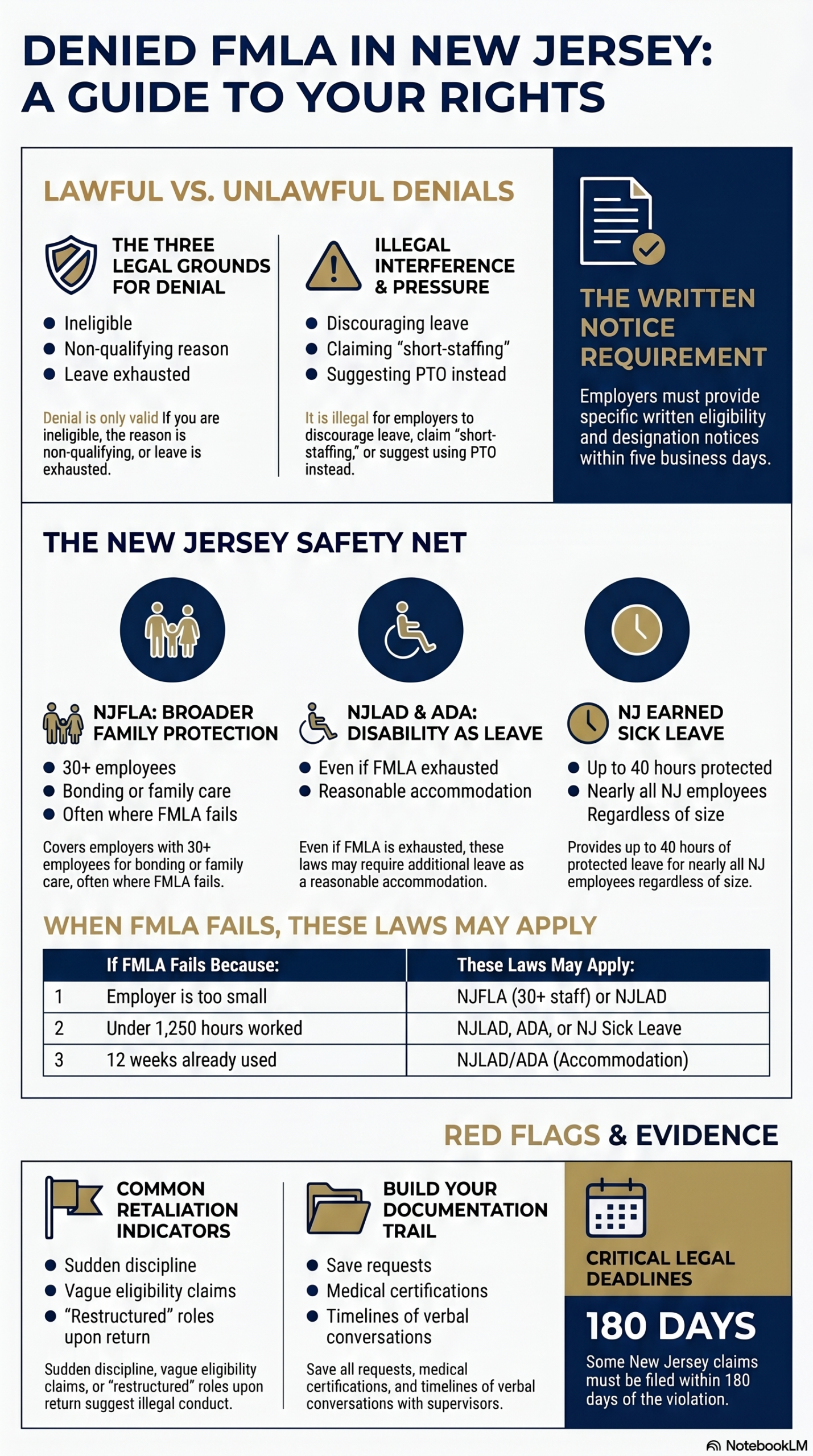
New Jersey FMLA Rights Guide
When an FMLA Denial Is Illegal
Outside the narrow categories above, refusing FMLA leave is illegal interference. Federal law prohibits employers from “interfering with, restraining, or denying the exercise of” FMLA rights — and that prohibition is broader than it sounds. It covers a wide range of behavior beyond an outright “no.”
The Most Common Wrongful Denials We See
Some FMLA denials are obvious. Most aren’t. The ones that show up most often in New Jersey consultations involve gray-area reasoning the employer treats as routine, but that doesn’t actually hold up under the law.
“You haven’t been here long enough”
Sometimes true, often miscounted. The 12-month requirement doesn’t have to be consecutive — prior periods of employment within seven years generally count, with limited exceptions. Employers occasionally count only a current stretch and miss earlier eligible time.
“You haven’t worked enough hours”
The 1,250-hour rule counts actual hours worked, not paid hours. That distinction can cut either way, and miscounts are common — especially for salaried employees, employees who work overtime, or employees whose schedules aren’t tracked carefully. If the answer is close to 1,250, it’s worth scrutinizing.
“This isn’t serious enough to qualify”
“Serious health condition” under FMLA is broader than many people realize. It includes conditions involving inpatient care, conditions requiring continuing treatment by a healthcare provider, chronic conditions, and conditions causing incapacity for more than three consecutive days when paired with treatment. Anxiety, depression, migraines, pregnancy complications, asthma, autoimmune conditions, and many others can qualify when properly certified.
“We can’t approve it because we’re short-staffed”
Not a lawful basis. Coverage difficulties are not a reason to deny FMLA leave to an eligible employee with a qualifying reason.
“Your certification is incomplete”
Sometimes legitimate, sometimes pretextual. The regulations specify exactly what an employer must do when a certification is incomplete: notify the employee in writing what’s missing, give a reasonable opportunity (at least seven calendar days) to cure the deficiency, and not deny leave outright while the cure period runs. Employers who reject certifications without following this process are interfering with FMLA rights.
“You took FMLA before, so you’ve used your time”
FMLA gives 12 weeks per 12-month period — and the employer’s chosen method for calculating that 12-month window matters enormously. Some methods reset the clock at calendar year, others use a rolling backward look. Errors in the method or the math are frequent.
“We don’t offer FMLA”
Employers don’t get to opt out of FMLA. If they meet the coverage threshold, the law applies regardless of what their handbook says.
“Your job will be eliminated when you come back”
Not on its own a defense. The employer must show the position would have been eliminated regardless of the leave — and reposting the role under a different title or filling it with a new hire often undercuts that claim.
What If You’re Not Eligible for FMLA?
This is one of the most important — and most overlooked — points. FMLA isn’t the only law that protects medical leave in New Jersey. If FMLA doesn’t apply, several other frameworks may.
Many FMLA denials shift the analysis but don’t end it. The question becomes: which other law might cover this leave?
NJFLA — Different Coverage, Different Rules
The New Jersey Family Leave Act provides up to 12 weeks of job-protected leave for caring for a family member with a serious health condition or bonding with a new child. NJFLA covers employers with 30 or more employees — broader than FMLA — and defines “family member” more inclusively. Important: NJFLA does not cover leave for your own serious health condition. That gap matters.
NJLAD and ADA — Disability Accommodation as Leave
If your need for leave is tied to a disability, the New Jersey Law Against Discrimination and the Americans with Disabilities Act may require leave as a reasonable accommodation, even if FMLA doesn’t apply. This is especially important when FMLA runs out and more time is needed. The employer is generally required to engage in an “interactive process” — and refusing to consider additional leave without that process is itself a legal vulnerability.
NJ Earned Sick Leave
Nearly every New Jersey employer must provide up to 40 hours of earned sick leave per year. There’s no eligibility threshold. Retaliation for using it is illegal. For shorter leaves, this is often the most accessible protection.
Do I Have a Case for Wrongful FMLA Denial?
The honest answer is that no article can tell you for certain — it depends on the facts, the employer, and the evidence. But there are clear signals that an FMLA denial deserves a closer look.
One flag doesn’t guarantee a viable claim. But two or three usually means the facts deserve a careful legal review before deadlines run.
The Notice Requirements Most Employers Get Wrong
FMLA imposes specific notice obligations on employers that often get overlooked — and missed notices can themselves be the basis of an interference claim. Within five business days of learning that an employee may need FMLA leave, the employer must generally:
- Give the employee a written Eligibility Notice stating whether they’re eligible (and if not, at least one reason why)
- Give a Rights and Responsibilities Notice explaining the employee’s specific rights and obligations under FMLA
- If a medical certification is required, request it in writing with at least 15 calendar days to provide it
- Once enough information is in, give a Designation Notice confirming whether the leave is FMLA-qualifying
If your employer denied your leave verbally, never gave you these written notices, or skipped the certification process entirely and went straight to “no,” those gaps may be part of the case — sometimes the strongest part.
The “Use Your PTO Instead” Trap
One pattern worth flagging on its own: employers occasionally tell employees to “just use your PTO” instead of formally requesting FMLA. This may sound helpful, but it can quietly cost the employee FMLA’s job protection.
FMLA allows employees and employers to run paid time off concurrently with FMLA — but only if the leave is properly designated as FMLA. If the absence is treated as ordinary PTO without an FMLA designation, the employee may lose the right to job restoration, the protection from termination based on the leave, and the count toward 12 weeks. If your employer suggested skipping FMLA paperwork “to keep things simple,” that’s worth a careful look.
Why Documentation Matters So Much in FMLA Cases
FMLA cases are won or lost on documentation. Employers don’t usually put bad motives in writing — but they often leave a trail of missing writing. The certifications never returned, the eligibility notices never sent, the designation never made. That trail tells the story.
That’s why one of the first things to do after a denied or discouraged FMLA request is to save everything: the request itself, any forms submitted, the doctor’s certification, every email and message about the leave, and any written rejection or pushback. If something was said verbally, write it down with the date and the people present.
The Proof Framework: What Evidence Matters
Examples That Often Signal Wrongful Denial
The fact patterns that come up most often in NJ consultations look something like this:
- An employee asks about FMLA after being diagnosed with a serious condition. HR says “we don’t really do that here” and offers PTO instead — and the employer has 60 employees.
- A worker submits a complete medical certification. The employer rejects it as “insufficient” without explaining what’s missing or giving time to cure, then denies the leave.
- An employee requests intermittent FMLA for a chronic condition. The employer requires re-certification every two weeks, demands detailed diagnosis information beyond the form, and disciplines the employee for “attendance” tied to the protected absences.
- A new parent asks for bonding leave. HR says they don’t qualify because they “haven’t been here a year” — but they previously worked for the same employer two years ago, and the prior period brings them over the 12-month threshold.
- An employee with anxiety and panic disorder requests FMLA. The supervisor says it isn’t “serious enough” without ever reviewing certification.
- A worker uses 11 weeks of FMLA for major surgery and recovery. With one week left, the employer abruptly says the leave is over and the position has been filled.
- An employee returns from FMLA to find that their job has been “restructured” and only an unrelated, lower-paying position is available.
None of these patterns automatically prove a violation. But each raises questions that an employment lawyer should look at closely.
What to Do If Your FMLA Request Was Denied
If your request was denied — or you suspect the denial was wrong — there are practical steps that preserve options without committing to anything.
- Get the denial in writing. If the denial was verbal, send a follow-up email asking the employer to confirm the denial in writing along with the specific reason. This both creates documentation and sometimes prompts the employer to reconsider.
- Save the medical certification. Keep a copy of any certification you submitted and any communication from your healthcare provider.
- Save all written notices — and note what’s missing. Eligibility Notices, Rights and Responsibilities Notices, and Designation Notices. If you didn’t receive them, that gap may matter.
- Document the verbal record. Write down — by date — what was said, by whom, in what meetings or calls. Memory fades fast and the details often turn out to matter.
- Don’t quit on a verbal denial. Some employees respond to a denial by resigning or stopping the request. That’s almost always the wrong move legally. Keep the paper trail going.
- Identify other potential coverage. If FMLA truly doesn’t apply, is the leave covered by NJFLA, NJLAD, ADA, or NJ Earned Sick Leave?
- Don’t sign any severance or release without review. If the denial leads to a termination offer, have someone review the severance agreement before signing.
- Note the deadlines. FMLA, NJLAD, ADA, and NJ Civil Rights filings all have different time limits.
- Talk to an employment lawyer before the deadlines run. A consultation can clarify which laws apply and whether the denial supports a claim.
Important Deadlines
These are general timeframes. Specific facts and procedural rules can shorten or extend them. Always confirm the exact deadline for your situation as early as possible.
Download Our Guide – Can Your Employer Deny FMLA Leave?
Download Our Guide – Can Your Employer Deny FMLA Leave?
Frequently Asked Questions
Can my employer deny my FMLA request because the timing is bad for the company?
No. Coverage difficulties, busy seasons, short staffing, and inconvenience are not lawful reasons to deny FMLA leave to an eligible employee with a qualifying reason. If you’re entitled to the leave, the employer’s operational concerns are not a valid basis for denial.
What if my employer didn’t give me any FMLA paperwork or written notice?
FMLA requires employers to provide specific written notices about eligibility, rights, and designation, generally within five business days of learning of the leave need. Failure to provide these notices is itself a potential FMLA violation, particularly if the missing notices caused the employee to lose protection or benefits.
Can my employer require a doctor’s note before approving FMLA?
Yes — but the request must be made in writing, the employee must be given at least 15 calendar days to provide it, and the employer can only request what FMLA regulations specifically allow. Demanding excessive medical detail or rejecting valid certifications without following the cure process can be interference.
What if my employer says I’m not eligible — but I think I am?
Eligibility errors are common. The 12-month requirement isn’t necessarily consecutive, hours worked may be miscounted, and the 50-employee-within-75-miles test is sometimes applied wrong. If the answer is close to the line, it’s worth a careful review.
Does the FMLA cover my own anxiety or depression?
It can. Mental health conditions can qualify as serious health conditions when they meet the regulatory criteria — typically when they involve continuing treatment by a healthcare provider or cause incapacity for more than three days paired with treatment. Properly documented mental health conditions are FMLA-qualifying as often as physical ones.
Can I be fired for requesting FMLA, even if the leave is denied?
No. Adverse action — including termination — taken because of an FMLA request is unlawful retaliation, regardless of whether the leave was ultimately granted or denied. The act of requesting protected leave is itself protected activity.
What if my FMLA runs out and I still need more time?
FMLA’s 12 weeks is not necessarily the end of the road. Under the NJLAD and ADA, additional finite leave can be a reasonable accommodation if it would allow you to return and perform the essential functions of the job. The employer is generally required to engage in an interactive process — and skipping that step is itself a vulnerability.
Should I file a complaint with the Department of Labor or hire a lawyer?
Both options exist and neither forecloses the other. The DOL’s Wage and Hour Division investigates FMLA complaints. Private FMLA lawsuits can be filed in federal court without first going through the DOL. An employment lawyer can advise on which path fits the specific facts and what evidence matters most.
The Bottom Line
Talk to an Employment Lawyer Before Your Deadline Runs
If your FMLA request was denied, discouraged, or quietly bypassed — and the reason doesn’t add up, the paperwork is missing, or you’re now facing discipline or termination — it’s worth a closer look. A confidential consultation can help you understand which New Jersey and federal laws apply, what evidence matters most, and what deadlines you’re working against.
Swartz Swidler represents employees across New Jersey, Pennsylvania, Philadelphia, and South Jersey. Reach out to schedule a confidential consultation — no pressure, just answers.