

Published by: Swartz Swidler LLC
Last updated: 06/01/2026
Jurisdiction note: This article is for employees in Pennsylvania, including Philadelphia and nearby areas. Employment laws and deadlines can vary based on the facts, employer, claim type, and location. This article is for general informational purposes only and is not legal advice.
Direct Answer
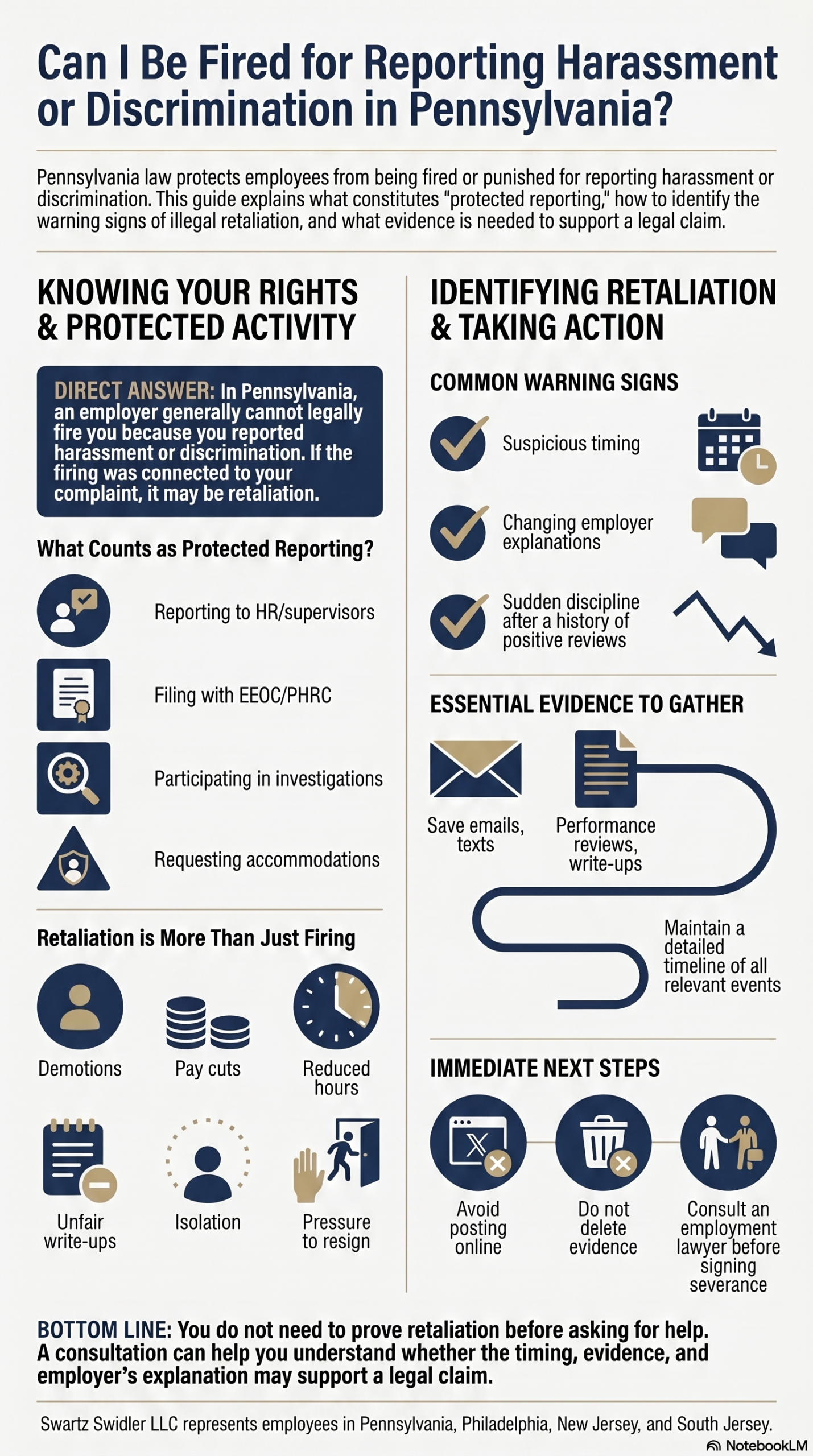
In Pennsylvania, your employer generally cannot legally fire you because you reported workplace harassment or discrimination. If you complained about discrimination, reported sexual harassment, participated in an investigation, filed a charge, or opposed conduct you reasonably believed was unlawful, firing you because of that protected activity may be illegal retaliation.
That does not mean every termination after a complaint is automatically unlawful. Pennsylvania employers may still discipline or terminate employees for legitimate, non-retaliatory reasons. The key question is whether your report of harassment or discrimination was a motivating reason for the firing, demotion, discipline, schedule change, pay cut, or other negative action.
If you were fired after reporting harassment or discrimination, the timeline, the employer’s explanation, your prior work history, and the evidence surrounding your complaint may all matter.
Quick Summary: When a Firing After a Complaint May Be Retaliation
You may want to speak with a Pennsylvania employment lawyer if:
- You reported harassment or discrimination and were fired shortly afterward.
- You complained to HR, a supervisor, management, the EEOC, the PHRC, or another agency.
- Your employer suddenly changed its attitude toward you after your complaint.
- You received new write-ups or discipline after reporting misconduct.
- Your employer’s reason for firing you does not match your work history.
- Other employees made similar mistakes but were not fired.
- You were excluded, demoted, transferred, suspended, or had your hours cut after speaking up.
- You were pressured to quit after reporting harassment or discrimination.
- You were told you were “not a team player,” “causing problems,” or “creating drama” after making a complaint.
A strong retaliation claim usually depends on three basic questions: Did you engage in protected activity? Did your employer take negative action against you? Is there evidence connecting the two?
 What Counts as Reporting Harassment or Discrimination?
Reporting harassment or discrimination can happen in several ways. It does not always require a formal lawsuit or agency charge.
Protected reporting may include:
- Telling a supervisor about discriminatory treatment
- Reporting sexual harassment to HR
- Sending an email complaint about racial, religious, disability, pregnancy, age, sex, national origin, sexual orientation, or gender identity harassment
- Complaining that coworkers or managers are making offensive protected-status comments
- Participating as a witness in a harassment or discrimination investigation
- Filing a charge with the Equal Employment Opportunity Commission
- Filing a complaint with the Pennsylvania Human Relations Commission
- Cooperating with another employee’s discrimination complaint
- Refusing to participate in discriminatory conduct
- Requesting a reasonable accommodation related to disability, pregnancy, or religion
The complaint does not need to use perfect legal language. Employees often do not say, “I am making a protected complaint under employment discrimination law.” They may say, “I am being treated differently because of my pregnancy,” “My supervisor keeps making sexual comments,” or “I think I am being targeted because of my race.”
The more clearly your complaint identifies discrimination, harassment, or a protected issue, the easier it may be to show that your employer understood you were raising a legally protected concern.
For broader guidance about workplace rights, Swartz Swidler’s employment law resources may help you understand related employee-side issues.
What Is Retaliation in a Pennsylvania Workplace?
Retaliation happens when an employer punishes an employee for engaging in protected activity. In this context, the protected activity is usually reporting or opposing harassment or discrimination.
Retaliation can involve more than firing. It may include:
- Termination
- Demotion
- Suspension
- Pay cuts
- Loss of hours
- Denial of promotion
- Unfavorable schedule changes
- Increased scrutiny
- Unjustified write-ups
- Transfer to a worse position
- Exclusion from meetings or opportunities
- Threats or intimidation
- Negative references
- Pressure to resign
- Hostility after a complaint
- Sudden performance criticism after a strong work history
The action must usually be significant enough that it could discourage a reasonable employee from making or supporting a discrimination or harassment complaint.
For example, a minor awkward interaction after a complaint may not be enough by itself. But being fired, demoted, suspended, written up, isolated, or stripped of responsibilities after reporting harassment may raise serious retaliation concerns.
Swartz Swidler has additional information on workplace retaliation and retaliation after reporting workplace issues.
Can My Employer Fire Me After I Report Harassment?
Your employer may be able to fire you after a harassment complaint if it has a legitimate, non-retaliatory reason. But your employer cannot fire you because you made the complaint.
This distinction matters.
An employer may claim the firing was based on performance, attendance, restructuring, policy violations, misconduct, or business needs. Sometimes those reasons are legitimate. Other times, they are used as cover for retaliation.
Questions that may help reveal the difference include:
- Did the firing happen soon after your complaint?
- Did your employer document performance issues before you complained?
- Were you receiving positive reviews before reporting harassment?
- Did your employer investigate your complaint fairly?
- Did the employer fire or discipline the harasser?
- Did management become hostile after your report?
- Did the employer give different reasons at different times?
- Were other employees treated more leniently for similar issues?
- Did the company skip normal disciplinary steps?
- Did the employer pressure you to resign instead of addressing the complaint?
The timing does not prove everything, but suspicious timing can be important. If you were fired days or weeks after reporting harassment, that timing may support a closer legal review, especially when combined with other evidence.
If your situation involved sexual harassment, you may also want to review Swartz Swidler’s guidance on what counts as sexual harassment and how to deal with sexual harassment at work.
Can My Employer Fire Me After I Report Discrimination?
The same basic rule applies to discrimination complaints. Your employer cannot legally fire you because you complained about discrimination based on a protected characteristic.
Protected characteristics may include race, color, sex, pregnancy, religion, disability, age, national origin, ancestry, and other categories protected under federal, state, or local law.
Examples of possible retaliation after a discrimination complaint include:
- You reported racial comments and were fired soon after.
- You complained that your supervisor treated pregnant employees worse and were demoted.
- You requested a disability accommodation and then received sudden discipline.
- You complained that older employees were being pushed out and were placed on a performance improvement plan.
- You supported a coworker’s discrimination complaint and then lost hours.
- You reported religious discrimination and were transferred to a worse shift.
The original discrimination complaint does not always need to be proven perfectly for retaliation protections to matter. In many cases, the issue is whether you reasonably and honestly opposed conduct that you believed was unlawful, and whether your employer punished you for doing so.
If your concern involves discrimination in Pennsylvania, Swartz Swidler’s page for employment attorneys in Pennsylvania may be a useful next step. If the issue happened in Philadelphia, you may also want to review the firm’s page for employment attorneys in Philadelphia.
What If the Harassment or Discrimination Complaint Was Internal?
Internal complaints can still be protected.
You do not necessarily have to file with the EEOC or PHRC before retaliation protections apply. Complaining to HR, a supervisor, a manager, compliance personnel, or another appropriate internal channel may be protected when you are reporting harassment, discrimination, or another unlawful practice.
That said, the way you report matters. A complaint that clearly connects the problem to harassment or discrimination is usually stronger than a vague complaint about unfairness.
For example:
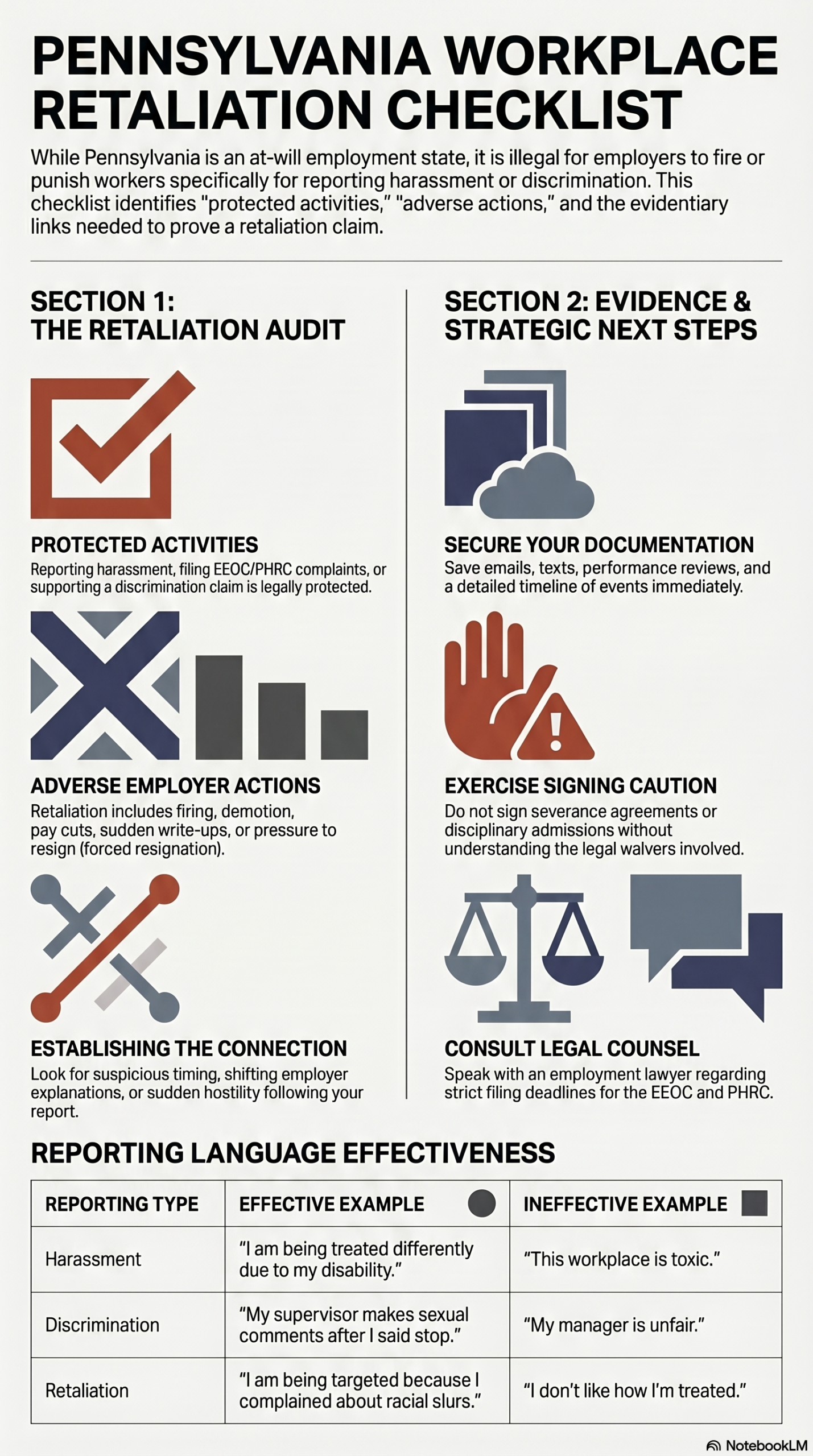
- Stronger: “I believe I am being treated differently because of my disability.”
- Stronger: “My supervisor keeps making sexual comments after I told him to stop.”
- Stronger: “I am being targeted because I complained about racial slurs.”
- Weaker: “This workplace is toxic.”
- Weaker: “My manager is unfair.”
- Weaker: “I do not like how I am being treated.”
The weaker statements may still matter as context, but they may be harder to connect to protected activity unless other facts show the employer knew the issue involved discrimination or harassment.
What If I Reported Harassment and Then Got Written Up?
A sudden write-up after a harassment or discrimination complaint can be a warning sign, especially if you had not been disciplined before.
A write-up may matter if it:
- Comes shortly after your complaint
- Raises issues that were never mentioned before
- Exaggerates minor mistakes
- Contradicts your prior reviews
- Is part of a pattern leading to termination
- Is used to justify a demotion, suspension, or firing
- Treats you more harshly than coworkers who did the same thing
Employers sometimes create a paper trail after an employee complains. A paper trail is not automatically unlawful. Employers are allowed to document legitimate performance or conduct issues. But if the documentation begins only after protected activity, appears exaggerated, or conflicts with past records, it may support a retaliation claim.
If you receive a write-up after reporting harassment or discrimination, avoid responding impulsively. Save a copy if you can legally access it. Write down what happened. Note whether the allegations are accurate, incomplete, or inconsistent with how others were treated. Consider speaking with an employment lawyer before signing anything that admits wrongdoing or waives rights.
What Evidence Helps Prove Retaliation?
Retaliation cases often depend on evidence that connects your complaint to the employer’s negative action.
Helpful evidence may include:
- Your written harassment or discrimination complaint
- Emails or texts to HR, supervisors, or managers
- Notes from meetings
- Witness names
- Performance reviews before and after the complaint
- Write-ups or disciplinary notices
- Termination letters
- Schedules showing reduced hours
- Pay records
- Messages showing hostility after your complaint
- Copies of company policies
- Evidence that other employees were treated differently
- A timeline of key events
- Agency charge documents, if applicable
A timeline can be especially important. Include dates for:
- When the harassment or discrimination happened
- When you reported it
- Who received the complaint
- How the employer responded
- When discipline started
- When you were fired, demoted, suspended, or otherwise punished
- What reason the employer gave
- Whether that reason changed over time
For more on evidence in retaliation cases, see Swartz Swidler’s article on what evidence helps prove workplace retaliation in New Jersey. Although that article focuses on New Jersey, many of the practical documentation concepts are useful for employees trying to understand how retaliation evidence works.
What If My Employer Says I Was Fired for Performance?
Employers often defend retaliation claims by saying the employee was fired for performance or misconduct. Sometimes that explanation is accurate. Other times, it may be pretext, meaning a stated reason used to hide the real reason.
Performance-based termination may deserve closer review if:
- You had positive reviews before complaining.
- You were never warned before the complaint.
- The employer skipped progressive discipline.
- The employer exaggerated small mistakes.
- The stated reason is vague.
- The employer changed its explanation.
- Other employees made similar mistakes and were not fired.
- The decisionmaker knew about your complaint.
- Management made negative comments about you reporting the issue.
- The termination happened soon after your complaint.
The strongest cases often combine timing with inconsistencies. For example, if your employer says you were fired for poor performance, but your records show strong reviews until you reported harassment, that conflict may matter.
Should I Report Harassment or Discrimination in Writing?
In many situations, written reporting can help create a record. A written complaint may reduce the employer’s ability to later claim it did not know about the issue.
A clear written complaint may include:
- What happened
- Who was involved
- When it happened
- Whether there were witnesses
- Why you believe the conduct was harassment or discrimination
- Whether the conduct relates to a protected characteristic
- What you are asking the employer to do
- A request that the employer not retaliate against you
You do not need to write a long legal memo. The goal is to be clear, factual, and professional.
For example:
“I am reporting that I believe I am being subjected to sexual harassment by [name]. On [date], [briefly describe conduct]. I previously told [person] that the conduct was unwelcome. I am asking the company to investigate and take steps to stop the harassment. I also ask that I not be retaliated against for making this report.”
If you are worried that reporting may put your job at risk, consider speaking with an employment attorney before taking the next step. This is especially important if the conduct is serious, if HR has ignored prior complaints, or if you already sense retaliation beginning.
What Should I Do If I Was Fired After Reporting Harassment or Discrimination?
If you were fired after making a complaint, take steps to protect your position.
Consider the following:
- Write down the timeline immediately.
Include the harassment or discrimination, your complaint, the employer’s response, and the termination. - Save documents you can legally access.
Preserve emails, texts, pay records, schedules, write-ups, performance reviews, termination letters, and severance agreements. - Do not alter or delete evidence.
Keep documents in their original form when possible. - Do not post details online.
Social media posts can complicate your claim and may be used by the employer. - Be careful with company property and confidential information.
Do not take documents you are not authorized to access. - Do not secretly record conversations without legal guidance.
Recording laws can create separate legal issues. - Save any severance agreement.
If your employer offers severance, the agreement may require you to waive claims. - Contact an employment lawyer promptly.
Deadlines may apply, and early guidance can help avoid mistakes.
If you were fired and believe the termination may be unlawful, Swartz Swidler’s wrongful termination attorneys page may help you understand how the firm evaluates termination-related claims.
Should I Sign a Severance Agreement After Being Fired?
If you were fired after reporting harassment or discrimination and then offered severance, be careful before signing.
A severance agreement may require you to release legal claims against your employer. That means you may be giving up the right to bring a retaliation, discrimination, harassment, wage, leave, or wrongful termination claim in exchange for payment or benefits.
Before signing, ask:
- Am I waiving retaliation claims?
- Am I waiving harassment or discrimination claims?
- Does the agreement include confidentiality or non-disparagement language?
- Am I being asked to give up rights before I understand what happened?
- Is the severance amount fair given the facts?
- Are there deadlines to sign or revoke?
- Can the terms be negotiated?
- Does the agreement affect unemployment, benefits, commissions, bonuses, or future employment?
If you believe the firing was connected to your complaint, it may be wise to have an employment attorney review the severance agreement before you sign. Swartz Swidler has additional guidance on severance agreements and severance negotiation tips in New Jersey. The negotiation concepts may still help employees understand what to consider before signing, even when Pennsylvania law applies.
How Long Do I Have to Act in Pennsylvania?
Deadlines in employment cases can be short and fact-specific. The deadline may depend on whether your claim is under federal law, Pennsylvania law, Philadelphia law, or another legal theory.
For many Pennsylvania discrimination and retaliation issues, employees may need to act within months, not years. Some claims may require filing first with an agency such as the EEOC or the Pennsylvania Human Relations Commission before filing a lawsuit.
Do not assume you have plenty of time. If you were fired, demoted, disciplined, or pressured to resign after reporting harassment or discrimination, it is better to speak with an employment lawyer sooner rather than later.
Can My Employer Retaliate Against Me for Helping a Coworker?
Employers generally cannot punish employees for participating in a discrimination or harassment investigation or supporting another employee’s protected complaint.
This may include:
- Serving as a witness
- Answering questions during an internal investigation
- Providing documents or information
- Confirming that harassment occurred
- Supporting a coworker’s EEOC or PHRC charge
- Opposing discriminatory treatment against someone else
Retaliation protection is not limited to the person who originally complained. Witnesses and employees who assist in protected proceedings may also have rights.
What If I Was Pressured to Quit Instead of Being Fired?
Some employees are not formally fired. Instead, the employer makes the job so difficult that the employee feels forced to resign.
This may involve:
- Cutting hours
- Changing schedules
- Removing duties
- Isolating the employee
- Increasing scrutiny
- Threatening discipline
- Ignoring harassment
- Refusing to address safety or discrimination concerns
- Creating intolerable working conditions after a complaint
Forced resignation cases can be difficult. Quitting may affect your legal claims and your unemployment options. If you believe your employer is trying to push you out because you reported harassment or discrimination, consider speaking with a lawyer before resigning.
What If the Employer’s Harassment Investigation Was Unfair?
An employer’s investigation can become relevant in a retaliation case.
Concerns may include:
- The employer ignored your complaint.
- HR interviewed you but did not interview key witnesses.
- The harasser was warned but you were punished.
- You were moved, but the harasser was not.
- The company revealed your complaint unnecessarily.
- The investigation focused on your behavior instead of the misconduct.
- You were disciplined after cooperating.
- The company closed the investigation without explaining anything.
- The harassment continued after you reported it.
An imperfect investigation does not automatically prove retaliation. But an unfair or one-sided investigation can be important evidence, especially if the employer used the process to justify discipline against the person who complained.
Common Examples of Potential Retaliation in Pennsylvania
Fired After Reporting Sexual Harassment
An employee reports repeated sexual comments by a supervisor. Two weeks later, the employee is fired for “poor attitude,” even though prior reviews were positive.
Demoted After Reporting Race Discrimination
An employee complains that coworkers are using racial slurs. Management tells the employee they are “too sensitive” and later removes them from a leadership role.
Written Up After Complaining to HR
An employee reports pregnancy discrimination. Shortly afterward, the employer issues the employee’s first written warning for minor issues that were previously ignored.
Hours Cut After Supporting a Coworker
An employee confirms that a coworker was sexually harassed. The employee’s hours are reduced the next week, while other employees keep their normal schedules.
Pushed Out After Filing an Agency Charge
An employee files a complaint with the PHRC or EEOC. After the employer learns about it, managers stop communicating, exclude the employee from meetings, and pressure the employee to resign.
These examples do not guarantee a case, but they show patterns that may deserve legal review.
 What Questions Should I Ask a Pennsylvania Employment Lawyer?
If you contact a lawyer after being fired for reporting harassment or discrimination, consider asking:
- Was my complaint protected activity?
- Does the timing support a retaliation claim?
- What evidence would matter most?
- Should I file with the EEOC, PHRC, or another agency?
- Are there deadlines I should know about?
- Should I respond to the employer’s stated reason for firing me?
- Should I sign the severance agreement?
- Can the employer contact me after termination?
- What damages may be available?
- What should I avoid doing right now?
You do not need to know the legal answer before contacting a lawyer. The consultation is often where the facts are sorted and the legal issues become clearer.
Swartz Swidler also has an article on what questions to ask an employment lawyer that may help you prepare.
Bottom Line
In Pennsylvania, an employer generally cannot fire you because you reported harassment or discrimination. If the firing, demotion, discipline, schedule change, pay cut, or forced resignation happened because you complained about unlawful workplace conduct, you may have a retaliation claim.
The strongest cases often involve a clear complaint, negative action, suspicious timing, inconsistent explanations, and evidence showing that the employer’s stated reason does not tell the full story.
If you were fired after reporting harassment or discrimination in Pennsylvania or Philadelphia, Swartz Swidler LLC can help you evaluate what happened, what evidence may matter, and what options may be available. Employment law deadlines can affect your rights, so it may be important to get guidance before signing documents, responding to HR, or assuming nothing can be done.
To discuss your situation, contact Swartz Swidler LLC through the firm’s website or call the office to speak with someone about your employment law concerns.
Frequently Asked Questions
Can I be fired for reporting harassment in Pennsylvania?
Your employer generally cannot legally fire you because you reported harassment based on a protected characteristic, such as sex, race, disability, religion, age, pregnancy, national origin, sexual orientation, gender identity, or another protected category. If the firing happened because of your complaint, it may be retaliation.
Can I be fired for reporting discrimination in Pennsylvania?
An employer generally cannot fire you because you reported workplace discrimination, participated in an investigation, filed a charge, or opposed discriminatory conduct. The key issue is whether the firing was connected to your protected activity.
What if my employer says I was fired for performance?
Your employer may claim performance was the reason. A lawyer may look at whether that reason is supported by prior reviews, documentation, discipline history, coworker comparisons, timing, and whether the explanation changed after your complaint.
Do I have to complain in writing to be protected?
Not always. Verbal complaints may be protected, but written complaints can make it easier to prove what you reported, when you reported it, and who received the complaint.
What if I complained to HR and nothing happened?
If HR ignored your complaint or the harassment continued, that may matter. If you were later punished for reporting the issue, the employer’s response may become important evidence in a retaliation claim.
Can I be retaliated against for helping a coworker report harassment?
Yes, retaliation protections may apply to employees who participate in investigations, serve as witnesses, or support another employee’s discrimination or harassment complaint.
Is a write-up after a harassment complaint retaliation?
It can be, depending on the facts. A write-up may be suspicious if it happens shortly after your complaint, conflicts with your prior work history, exaggerates minor issues, or is used to build a case for termination.
What evidence should I save?
Save emails, texts, HR complaints, write-ups, performance reviews, schedules, pay records, termination letters, witness names, and a timeline of events. Do not take confidential company documents you are not authorized to access.
Should I sign a severance agreement after being fired?
Be careful. Severance agreements often require employees to waive legal claims. If you believe you were fired for reporting harassment or discrimination, consider having an employment lawyer review the agreement before signing.
How soon should I contact a lawyer?
Sooner is usually better. Pennsylvania employment retaliation and discrimination claims may involve short filing deadlines, and evidence can become harder to gather over time.