

Published by: Swartz Swidler LLC
Last updated: 06/08/2026
Jurisdiction note: This article is for employees in New Jersey, Pennsylvania, Philadelphia, and South Jersey. Overtime rights can depend on federal law, state law, job duties, pay structure, employer coverage, and the facts of the work performed. This article is for general informational purposes only and is not legal advice.
Direct Answer
Yes, you may be owed unpaid overtime even if you are paid a salary. In New Jersey and Pennsylvania, being “salaried” does not automatically make you exempt from overtime. Many salaried employees are still legally entitled to overtime pay when they work more than 40 hours in a workweek.
The key question is not simply whether your employer pays you a salary. The real question is whether you are properly classified as exempt or non-exempt under wage and hour law. That classification usually depends on your actual job duties, how you are paid, how much you are paid, and whether a specific overtime exemption applies.
If your employer pays you a salary but you regularly work nights, weekends, long shifts, or more than 40 hours per week without overtime pay, your classification may deserve closer review.
Quick Summary: Salaried Employees and Overtime in NJ and PA
You may want to speak with an employment lawyer if:
- You are paid a salary but regularly work more than 40 hours per week.
- Your employer says “salary means no overtime.”
- You have a manager title but limited real authority.
- You do not hire, fire, supervise, or make major decisions.
- Your primary job is production, customer service, sales support, clerical work, dispatching, manual work, or routine office work.
- Your employer recently changed you from hourly to salary but your job duties stayed the same.
- Your pay stubs do not show overtime even though you work long hours.
- You are expected to answer calls, emails, messages, or complete work after hours.
- You were told to work off the clock or not record certain hours.
- Your employer misclassified you as an independent contractor or exempt employee.
A salary is only one piece of the analysis. Your job title alone does not decide whether you are owed overtime.
Have a quick question?
Can salaried employees get overtime?
– Yes, some salaried employees can still be owed overtime if they are non-exempt and work more than 40 hours in a workweek.Does my manager title matter?
– It may matter, but it does not decide the issue by itself. Actual job duties are more important than title.What should I save?
– Pay stubs, schedules, job descriptions, emails, time records, and notes about your weekly hours and actual duties.

Salaried overtime checklist for New Jersey and Pennsylvania employees
Why Salaried Employees Often Get Confused About Overtime
Many employees assume that hourly workers get overtime and salaried workers do not. Employers sometimes reinforce this misunderstanding by saying things like:
- “You are salary, so overtime does not apply.”
- “Managers do not get overtime.”
- “You agreed to a fixed salary.”
- “Overtime is already built into your pay.”
- “This is just part of the job.”
- “You are exempt because your title is supervisor.”
- “You are a professional employee.”
- “Everyone in this position is salaried.”
Those statements may or may not be legally correct.
The law does not look only at the label your employer uses. It looks at the reality of your job. If you are salaried but non-exempt, you generally must be paid overtime when you work more than 40 hours in a workweek.
If you believe you may have been underpaid, Swartz Swidler’s resources on unpaid wages and overtime cases may help you understand related wage and hour issues.
What Does “Exempt” Mean?
In overtime law, “exempt” means an employee is excluded from certain overtime protections. If you are properly classified as exempt, your employer may not have to pay you overtime for hours over 40.
If you are non-exempt, you are generally entitled to overtime pay for hours worked over 40 in a workweek.
The confusion usually happens because employers sometimes classify employees as exempt when they should not be.
To be exempt under the most common white-collar exemptions, an employee usually must satisfy several requirements. These often include:
- Being paid on a salary basis
- Earning at least the required salary threshold
- Performing the type of actual job duties required for the exemption
The job duties requirement is often where disputes arise. A title such as “manager,” “administrator,” “coordinator,” “assistant manager,” “team lead,” or “supervisor” does not automatically make someone exempt.
Salary Alone Does Not Decide Overtime Rights
A salaried employee can be either exempt or non-exempt.
For example:
- A high-level executive with real management authority may be exempt.
- A salaried office worker performing routine clerical tasks may be non-exempt.
- A salaried assistant manager who spends most of the day doing the same work as hourly employees may be non-exempt.
- A salaried customer service supervisor with little authority over hiring, firing, discipline, or policy decisions may be non-exempt.
- A salaried employee with a professional-sounding title may still be owed overtime if their actual duties do not meet the legal test.
This is why job duties matter so much. A salaried worker who performs mostly routine, manual, support, customer-facing, or production work may still be entitled to overtime.
The Three Main Questions to Ask
If you are salaried and working more than 40 hours, start with these questions:
1. How much am I paid?
As of the date this article is updated, the federal standard salary level for many executive, administrative, and professional exemptions is $684 per week. However, salary thresholds can change, and state law may provide additional protections in some circumstances.
If your salary is below the required threshold for the claimed exemption, that may be a sign you are not properly classified as exempt.
2. Am I paid on a true salary basis?
Being paid on a salary basis generally means you receive a predetermined amount of pay that is not reduced based on the quality or quantity of your work, subject to specific legal exceptions.
If your employer docks your pay in ways that are inconsistent with salaried exempt status, that may raise questions about whether you are truly exempt.
3. What are my actual job duties?
This is often the most important question. Your day-to-day work matters more than your title.
Ask yourself:
- Do I manage a department or business unit?
- Do I supervise at least two full-time employees?
- Do my recommendations about hiring, firing, promotion, or discipline carry real weight?
- Do I exercise independent judgment on significant business matters?
- Do I perform advanced work requiring specialized education?
- Or do I mostly follow set procedures, complete assigned tasks, serve customers, perform production work, process paperwork, handle calls, schedule employees, enter data, make deliveries, or perform routine work?
If your actual duties do not match the claimed exemption, you may be owed overtime.
Common Exemptions Employers Use
Employers often rely on several common exemptions. Whether they apply depends on the facts.
Executive Exemption
This may apply to employees whose primary duty is management, who regularly direct the work of other employees, and who have meaningful authority or influence over hiring, firing, promotion, or discipline.
But not every “manager” is truly exempt.
For example, an assistant manager who spends most of the shift stocking shelves, serving customers, running a register, cleaning, or doing the same work as hourly employees may not be exempt simply because of the title.
Administrative Exemption
This may apply to employees who perform office or non-manual work related to management or general business operations and exercise independent judgment on important matters.
This exemption is often misunderstood. Routine office work, clerical work, data entry, scheduling, payroll processing, customer service, or following established procedures may not be enough.
A salaried employee can work in an office and still be non-exempt.
Professional Exemption
This may apply to employees performing work requiring advanced knowledge in a field of science or learning, usually obtained through prolonged specialized education.
But having experience, training, or a professional-sounding job title does not automatically make someone exempt.
Computer Employee Exemption
Certain computer employees may be exempt if they meet specific legal requirements. However, not every IT worker, help desk employee, support technician, or systems user is exempt. The actual work performed matters.
Outside Sales Exemption
Outside sales employees may be treated differently if their primary duty is making sales away from the employer’s place of business. But inside sales employees, call center sales employees, and account support employees may not fall into this exemption just because they are involved in sales.
Because exemptions are fact-specific, employees should be cautious about accepting an employer’s label at face value.
Common Jobs Where Salaried Employees May Be Misclassified
Misclassification can happen in many industries. Salaried employees who may deserve closer review include:
- Assistant managers
- Shift managers
- Retail managers
- Restaurant managers
- Office managers
- Dispatchers
- Customer service supervisors
- Call center supervisors
- Sales coordinators
- Inside sales representatives
- Account managers
- Recruiters
- Payroll or HR coordinators
- Administrative assistants
- Construction project coordinators
- Field supervisors
- Warehouse supervisors
- Logistics coordinators
- Healthcare administrative staff
- IT support or help desk workers
- Marketing coordinators
- Production supervisors with limited authority
These titles do not automatically mean someone is owed overtime. They are examples of roles where the title may sound exempt, but the actual duties may tell a different story.
New Jersey Salaried Employees and Overtime
In New Jersey, covered non-exempt employees generally must be paid overtime when they work more than 40 hours in a workweek. Paying someone a salary does not automatically remove that right.
New Jersey wage and hour law includes overtime exemptions, including certain executive, administrative, and professional employees. But those exemptions are not based on title alone.
If you work in New Jersey and are paid a salary, your overtime rights may depend on:
- Whether you are covered by New Jersey wage and hour law
- Whether you are covered by federal overtime law
- Whether your employer classified you as exempt
- Whether your actual duties satisfy an exemption
- Whether your pay structure satisfies salary requirements
- How many hours you actually worked each workweek
- Whether your employer kept accurate time records
For example, a salaried employee in South Jersey who works 50 to 60 hours a week but spends most of their time handling customer complaints, processing orders, performing manual tasks, or following detailed instructions may have questions worth reviewing.
If you work in New Jersey and believe your salary classification is being used to avoid overtime pay, Swartz Swidler’s page for employment attorneys in New Jersey may be a helpful next step.
Pennsylvania Salaried Employees and Overtime
In Pennsylvania, salaried employees may also be entitled to overtime if they are non-exempt. Pennsylvania guidance recognizes that a non-exempt salaried employee’s regular rate can be calculated from weekly remuneration, and overtime may be owed for hours over 40.
This can matter for employees in Philadelphia and throughout Pennsylvania who are paid a fixed weekly salary but regularly work long hours.
For example, if a Pennsylvania employee is paid a weekly salary and works 50 hours, the legal question is not simply, “Was the employee salaried?” The question is whether the employee was exempt. If not, overtime may be owed.
Pennsylvania employees should also pay attention to whether their employer:
- Tracks hours accurately
- Includes commissions, bonuses, or other compensation when calculating the regular rate where required
- Treats salaried employees as exempt without analyzing duties
- Uses “manager” titles for employees with limited authority
- Requires off-the-clock work before or after scheduled shifts
- Changes employees from hourly to salary to avoid overtime
If your issue happened in Philadelphia or elsewhere in Pennsylvania, Swartz Swidler’s page for employment attorneys in Philadelphia may be useful.
What If My Employer Changed Me From Hourly to Salary?
A change from hourly to salary does not automatically eliminate overtime rights.
This is a common red flag when the employee’s job duties stayed mostly the same. For example:
- You were hourly and received overtime.
- Your employer changed you to salary.
- Your duties did not meaningfully change.
- You still work more than 40 hours.
- Your employer stopped paying overtime.
That situation does not automatically prove a violation, but it deserves closer review. Employers cannot avoid overtime simply by changing a pay label.
If the real reason for the change was to avoid overtime while keeping the same non-exempt duties, you may be owed unpaid overtime.
What If My Title Is “Manager”?
A manager title does not decide the issue.
Many employees are called managers even though they have little real management authority. Ask yourself:
- Do I have the authority to hire or fire employees?
- Are my recommendations about discipline or promotion usually followed?
- Do I control schedules or merely follow a schedule created by someone else?
- Do I make meaningful business decisions?
- Do I manage the business or mostly perform the same work as hourly employees?
- Do I supervise full-time employees as a primary duty?
- Am I responsible for a recognized department or unit?
- Do I spend most of my time on non-managerial tasks?
If your “manager” role mainly involves doing the same work as hourly staff, opening and closing, covering shifts, handling customers, stocking, cleaning, entering data, or following company rules without real discretion, you may not be exempt.

Salaried employee reviewing pay stubs and overtime records in NJ or PA
What If My Employer Says Overtime Is Included in My Salary?
An employer may say your salary “covers all hours,” but that does not automatically make the arrangement legal.
If you are non-exempt, overtime rules still matter. The employer may need to calculate your regular rate and pay overtime for hours over 40 according to the applicable law.
This issue can become more complicated when salaries, bonuses, commissions, shift differentials, or fluctuating schedules are involved. The calculation may also differ depending on whether New Jersey law, Pennsylvania law, federal law, or a specific pay arrangement applies.
If you are unsure how your overtime should have been calculated, gather your pay stubs, schedules, and records of hours worked before speaking with a lawyer.
What Counts as Hours Worked?
Many unpaid overtime cases involve more than scheduled shift time. Hours worked may include required or permitted work performed before, during, or after a shift.
Depending on the facts, hours worked may include:
- Pre-shift setup
- Post-shift closing duties
- Required meetings
- Time spent answering work calls or emails
- Time spent responding to messages after hours
- Time spent completing reports from home
- Required training
- Certain travel time during the workday
- Time spent waiting or being controlled by the employer
- Work performed during unpaid meal breaks
- Work performed before clocking in or after clocking out
If your employer knew or should have known you were working, those hours may matter even if they were not properly recorded.
Swartz Swidler also has guidance on timecard falsification and FLSA overtime rules.
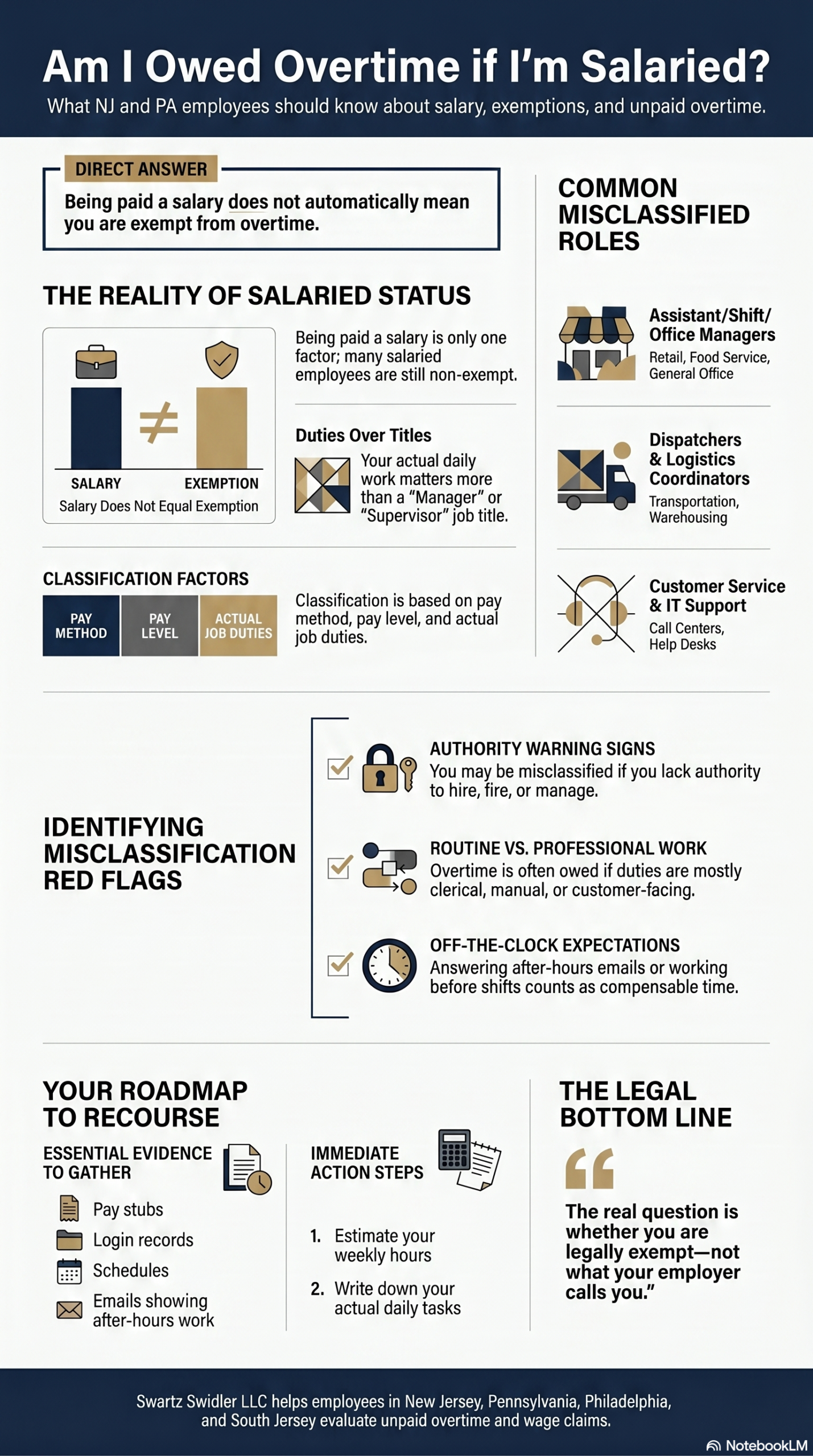
Salaried employee overtime rights infographic for NJ and PA workers
Evidence That May Help a Salaried Overtime Claim
You do not need perfect records before contacting a lawyer. Employers are often responsible for keeping accurate wage and hour records. Still, the more information you can gather, the easier it may be to evaluate your claim.
Helpful evidence may include:
- Pay stubs
- Offer letters
- Employment agreements
- Job descriptions
- Employee handbooks
- Schedules
- Timesheets or time clock records
- Emails showing work after hours
- Text messages with supervisors
- Slack, Teams, or other workplace messages
- Login records
- Call logs
- GPS or delivery records
- Calendars
- Work assignments
- Performance reviews
- Organizational charts
- Records showing who supervised whom
- Notes about actual job duties
- A personal estimate of hours worked each week
If you do not have all of this, start with a timeline. Write down your typical weekly schedule, how many hours you worked, what tasks you performed, and how your employer described your role.
How to Estimate Whether You May Be Owed Overtime
You can start by asking practical questions:
- How many hours do I usually work each week?
- How many weeks did I work more than 40 hours?
- What is my weekly salary?
- Did I receive any overtime premium?
- Did my duties actually qualify me as exempt?
- Did my employer track my hours?
- Did I perform work before or after scheduled hours?
- Did I receive bonuses, commissions, or other compensation that may affect the regular rate?
- Did my job title match my real authority?
- Did my employer change my pay method without changing my duties?
Do not rely only on your employer’s classification. If you worked more than 40 hours and were not paid overtime, the exemption analysis may matter more than what your employer called you.
Common Employer Mistakes in Salaried Overtime Cases
Employers may violate overtime laws by:
- Assuming all salaried employees are exempt
- Giving employees manager titles without real management duties
- Failing to track salaried non-exempt employees’ hours
- Changing employees from hourly to salary to avoid overtime
- Treating assistant managers as exempt when they mainly perform hourly work
- Ignoring work done before or after scheduled shifts
- Excluding bonuses, commissions, or other compensation from overtime calculations where they should be included
- Telling employees not to record overtime
- Automatically deducting meal breaks even when employees worked through them
- Misclassifying employees as independent contractors
- Averaging hours across two workweeks instead of analyzing each workweek separately
These issues often affect multiple employees in the same workplace. If your coworkers have the same title, salary structure, and overtime problem, there may be broader wage and hour concerns.
What Should You Do if You Think You Are Owed Overtime?
If you think your employer misclassified you as salaried exempt, consider these steps:
- Write down your actual job duties.
Focus on what you really do each day, not just your title or written job description. - Estimate your weekly hours.
Identify how often you work more than 40 hours and what tasks are performed during those extra hours. - Save pay records and schedules.
Keep pay stubs, schedules, emails, time records, and other documents you can legally access. - Do not alter or delete records.
Preserve documents in their original form when possible. - Avoid taking confidential company information.
Save information you are allowed to access, but do not improperly take private, confidential, or privileged materials. - Be careful before signing anything.
Severance agreements, releases, arbitration agreements, or settlement documents may affect your rights. - Speak with an employment lawyer if the issue involves significant unpaid overtime.
Wage and hour claims can involve deadlines, record issues, and classification analysis.
If you were recently fired or offered severance after raising overtime concerns, you may also want to review Swartz Swidler’s pages on wrongful termination attorneys and severance agreements.
Can My Employer Retaliate if I Ask About Overtime?
Employers generally should not punish employees for raising legitimate wage and hour concerns. Retaliation may include firing, demotion, discipline, reduced hours, schedule changes, threats, or pressure to quit after an employee complains about unpaid overtime or wages.
Examples of possible retaliation include:
- You asked why salaried employees are not paid overtime and were written up.
- You complained about unpaid overtime and your schedule was cut.
- You asked HR about your classification and were terminated soon after.
- You discussed overtime rights with coworkers and management threatened discipline.
- You filed a wage complaint and your employer began treating you differently.
If you were punished after raising overtime concerns, your case may involve both unpaid wages and retaliation. Swartz Swidler’s content on workplace retaliation may help you understand the broader issue.
Should You Contact a Lawyer Over Unpaid Overtime?
You may want to contact an employment lawyer if your unpaid overtime appears significant, lasted for months or years, affected multiple employees, or involved intentional misclassification.
An employment lawyer can help evaluate:
- Whether your job was properly classified
- Whether your salary met the required threshold
- Whether your duties fit an exemption
- Whether your hours were accurately recorded
- Whether bonuses, commissions, or other pay should affect the calculation
- How far back your claim may reach
- Whether your employer retaliated after you raised concerns
- Whether coworkers may have similar claims
- Whether a severance agreement or arbitration agreement affects your options
You do not have to know the answer before contacting a lawyer. If you are salaried, working long hours, and not receiving overtime, that may be enough to ask whether your classification is correct.
Swartz Swidler LLC helps employees in New Jersey, Pennsylvania, Philadelphia, and South Jersey evaluate wage and hour issues, including unpaid overtime, salary misclassification, unpaid wages, and retaliation after wage complaints. If you believe your salary is being used to deny overtime you may be legally owed, the firm can help you understand your options and what evidence may matter.
Bottom Line
Being paid a salary does not automatically mean you are exempt from overtime. In New Jersey and Pennsylvania, many salaried employees are still entitled to overtime if they are non-exempt and work more than 40 hours in a workweek.
The most important questions are:
- What are your actual job duties?
- How much are you paid?
- Are you paid on a true salary basis?
- Does a specific exemption really apply?
- How many hours did you work over 40?
- Did your employer accurately track and pay those hours?
If your title sounds important but your actual work is routine, controlled, customer-facing, manual, production-based, or lacking real decision-making authority, your salaried classification may deserve closer review.
Frequently Asked Questions
Am I owed overtime if I am salaried in New Jersey?
You may be owed overtime if you are salaried but non-exempt and worked more than 40 hours in a workweek. New Jersey law generally requires covered non-exempt employees to receive overtime pay for hours over 40, with certain exemptions.
Am I owed overtime if I am salaried in Pennsylvania?
You may be owed overtime if you are salaried but do not qualify for an exemption. Pennsylvania recognizes that non-exempt salaried employees may be owed overtime for hours worked over 40 in a workweek.
Does a salary automatically make me exempt from overtime?
No. Salary alone does not decide whether you are exempt. Your pay level, salary basis, job duties, and the specific exemption claimed by the employer all matter.
What if my title is manager?
A manager title does not automatically make you exempt. If you do not have real management authority, do not supervise employees as a primary duty, or spend most of your time doing the same work as hourly employees, your classification may deserve review.
What if I agreed to the salary?
Agreeing to a salary does not necessarily waive your right to overtime if you are legally non-exempt. Employers generally cannot avoid overtime obligations simply by having an employee accept a fixed salary.
What if my employer says overtime is included in my salary?
That statement may not be enough. If you are non-exempt, the employer may still have to calculate and pay overtime according to applicable law.
Can I get overtime for working from home after hours?
Possibly. If your employer knew or should have known you were performing work after hours, that time may count as hours worked, depending on the facts.
What if my employer did not track my hours because I was salaried?
That can be a problem for the employer, especially if you were actually non-exempt. Employers generally have recordkeeping obligations for covered non-exempt employees.
Can I be fired for asking about unpaid overtime?
Your employer should not retaliate against you for raising legitimate wage and hour concerns. If you were fired, disciplined, or punished after asking about unpaid overtime, you may have additional legal issues to review.
What should I bring to an overtime consultation?
Bring pay stubs, schedules, job descriptions, offer letters, emails, time records, messages, notes about job duties, and your best estimate of weekly hours worked. A timeline can also help.