

Published by: Swartz Swidler LLC
Last updated: 06/15/2026
Jurisdiction note: This article is for employees in New Jersey, Pennsylvania, Philadelphia, and South Jersey. Filing deadlines can vary based on the type of claim, the employer, the agency involved, whether the claim is state or federal, and the facts of the case. This article is for general informational purposes only and is not legal advice.
Direct Answer
The deadline to file a discrimination or wage claim in New Jersey or Pennsylvania depends on the type of claim and where you file it. Some discrimination complaints must be filed with an agency within 180 or 300 days. Some wage claims may go back two, three, or six years, depending on whether the claim is under federal law, New Jersey law, Pennsylvania law, or a wage contract statute.
The safest answer is this: do not wait. If you believe you were discriminated against, retaliated against, harassed, denied wages, denied overtime, or misclassified, speak with an employment lawyer as soon as possible. Missing a filing deadline can reduce or eliminate your ability to recover.
Why Employment Law Deadlines Are So Confusing
Employment law deadlines are confusing because “filing a claim” can mean different things.
An employee might need to:
- File a charge with the EEOC
- File a complaint with the New Jersey Division on Civil Rights
- File a complaint with the Pennsylvania Human Relations Commission
- File a wage complaint with a state labor agency
- File a lawsuit in court
- Act after receiving a Right to Sue notice
- Respond to a severance deadline
- Preserve claims before signing a release
Those are not all the same thing.
A discrimination claim may have one deadline for an agency filing and another deadline for a lawsuit. A wage claim may have one lookback period under federal law and a different deadline under state law. A retaliation claim may overlap with discrimination, wages, FMLA, whistleblowing, or wrongful termination.
This is why employees should be careful about relying on one general deadline from the internet. The right deadline depends on the legal theory and the facts.
If you are still trying to identify whether your issue may be a case, you may also want to review Swartz Swidler’s article on whether you have an employment law case.
Discrimination Claim Deadlines in New Jersey
New Jersey employees may have several possible filing paths for discrimination, harassment, and retaliation claims.
Common New Jersey discrimination issues may involve:
- Race discrimination
- Sex discrimination
- Pregnancy discrimination
- Disability discrimination
- Age discrimination
- Religious discrimination
- National origin discrimination
- Sexual orientation discrimination
- Gender identity discrimination
- Hostile work environment claims
- Retaliation after reporting discrimination or harassment
- Failure to accommodate
- Wrongful termination connected to protected status
Filing With the New Jersey Division on Civil Rights
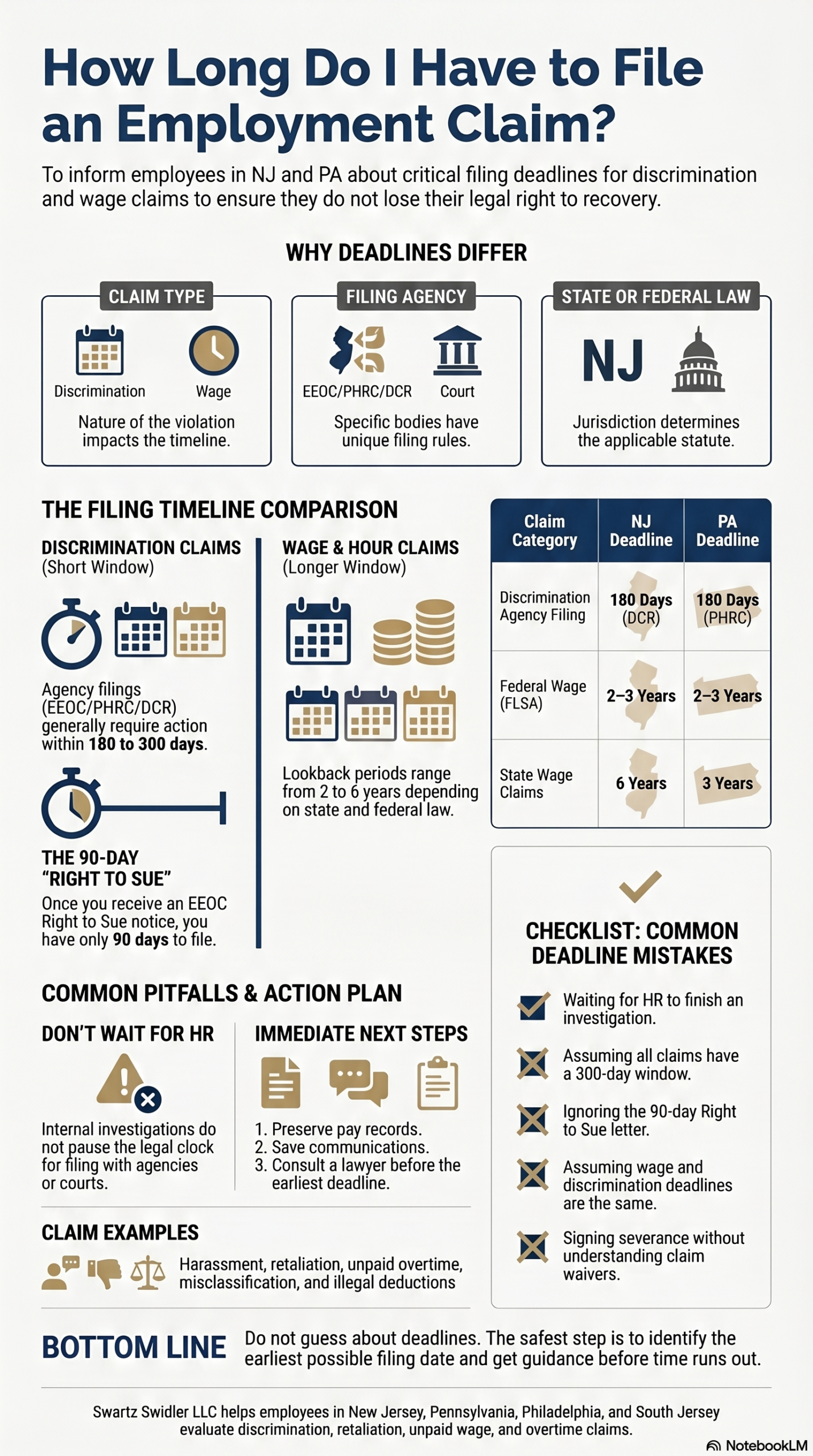
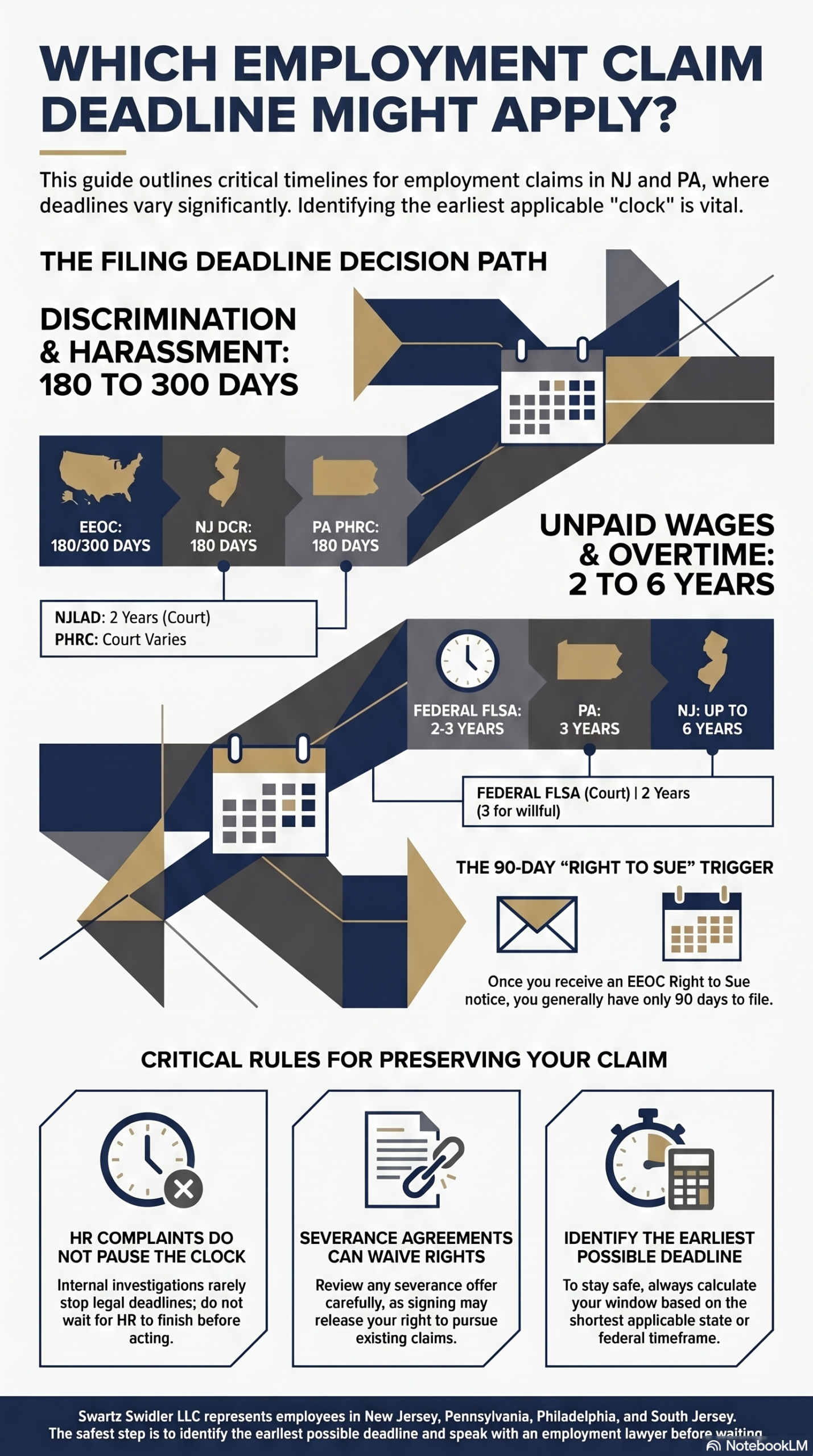
If you file with the New Jersey Division on Civil Rights, the deadline is generally 180 days from the incident. This may apply to complaints under the New Jersey Law Against Discrimination or related laws enforced by the DCR.
That is a short window. Six months can pass quickly, especially if you are still employed, trying to resolve the issue internally, waiting for HR, or recovering from termination.
Filing a Lawsuit Under New Jersey Law
For many New Jersey Law Against Discrimination claims filed in court, employees often have a separate deadline that may be longer than the DCR filing period. Many NJLAD discrimination, harassment, and retaliation claims are subject to a two-year statute of limitations.
This distinction matters. A person may miss the DCR administrative deadline but still need to ask whether a court claim is available. On the other hand, waiting too long can create evidence problems even if a court deadline has not expired.
Pay Discrimination and Wage-Related Claims May Be Different
Some pay-related discrimination claims and wage claims can involve different timing rules. If the issue involves unequal pay, unpaid wages, unpaid overtime, misclassification, commissions, or final pay, do not assume the same deadline applies as a standard discrimination case.
If the issue involves discrimination in New Jersey, Swartz Swidler’s page for employment attorneys in New Jersey may be a useful next step.

Discrimination Claim Deadlines in Pennsylvania
Pennsylvania employees also need to be careful with agency deadlines.
Common Pennsylvania discrimination issues may involve:
- Race discrimination
- Sex discrimination
- Pregnancy discrimination
- Disability discrimination
- Age discrimination
- Religious discrimination
- National origin discrimination
- Sexual harassment
- Hostile work environment claims
- Retaliation after a complaint
- Failure to accommodate
- Termination after reporting discrimination or harassment
Filing With the Pennsylvania Human Relations Commission
In Pennsylvania, employees generally have 180 days from the alleged discrimination to file with the Pennsylvania Human Relations Commission.
This deadline can be especially important because Pennsylvania state-law discrimination claims often start with the PHRC process. If you wait too long, you may lose important state-law options.
Filing With the EEOC
Federal discrimination claims often involve the EEOC. In states such as Pennsylvania, where a state agency also enforces discrimination laws, the EEOC deadline is often 300 days for many claims. However, employees should not assume 300 days applies to every situation.
The safest approach is to contact a lawyer or the agency promptly. A missed filing deadline can create serious problems even when the facts are strong.
If the issue happened in Philadelphia or elsewhere in Pennsylvania, Swartz Swidler’s pages for employment attorneys in Pennsylvania and employment attorneys in Philadelphia may help you understand your options.
 Federal Discrimination Deadlines: EEOC and Right to Sue
Many workplace discrimination claims under federal law require an employee to file a charge with the EEOC before filing a lawsuit.
Federal claims may involve:
- Title VII discrimination or harassment
- ADA disability discrimination
- ADEA age discrimination
- Pregnancy discrimination under federal law
- Retaliation under federal anti-discrimination laws
For many private-sector employees, the EEOC filing deadline is generally 180 days, but it may extend to 300 days if a state or local agency enforces a law prohibiting employment discrimination on the same basis.
After the EEOC process, an employee may receive a Notice of Right to Sue. Once that notice is received, the employee generally has 90 days to file a lawsuit in court.
That 90-day deadline is one of the most important deadlines employees should not ignore. If you receive a Right to Sue notice, do not place it in a drawer and wait. The clock may already be running.
Swartz Swidler has related information on what happens after filing an EEOC charge and what the EEOC does.
Wage Claim Deadlines in New Jersey
Wage claims are different from discrimination claims. They often involve longer lookback periods, but that does not mean employees should wait.
New Jersey wage claims may involve:
- Unpaid overtime
- Minimum wage violations
- Off-the-clock work
- Unpaid final wages
- Unpaid commissions
- Illegal deductions
- Misclassification as exempt
- Misclassification as an independent contractor
- Timecard changes
- Failure to pay for required work before or after a shift
For many New Jersey wage complaints, including unpaid minimum wage and overtime complaints, the statute of limitations is six years.
That longer period can matter if an employer has underpaid workers for years. But waiting can still hurt a claim because documents may disappear, witnesses may leave, and memories may fade.
If you believe your employer owes you wages, Swartz Swidler’s pages on unpaid wages, overtime cases, and salaried overtime in NJ or PA may be helpful.
Wage Claim Deadlines in Pennsylvania
Pennsylvania wage claims may involve several possible laws, including the Pennsylvania Wage Payment and Collection Law, Pennsylvania Minimum Wage Act, federal Fair Labor Standards Act, employment agreements, commission plans, or other legal theories.
Pennsylvania wage issues may involve:
- Unpaid final wages
- Unpaid commissions
- Unpaid bonuses
- Unpaid overtime
- Minimum wage violations
- Illegal deductions
- Misclassification
- Failure to pay promised wages
- Failure to follow the agreed pay rate or pay schedule
Under the Pennsylvania Wage Payment and Collection Law, claims for unpaid wages or liquidated damages generally cannot be brought more than three years after the wages were due and payable.
Federal FLSA claims may also apply, especially to unpaid minimum wage or overtime. Under federal law, unpaid wage and overtime claims generally go back two years, or three years if the violation was willful.
The important point is that Pennsylvania wage claims can involve more than one law. A lawyer may need to evaluate which law applies, which deadline controls, and what wages can be recovered.
What If I Have Both a Discrimination Claim and a Wage Claim?
Some employees have more than one type of employment claim.
For example:
- You complained about unpaid overtime and were fired.
- You were denied commissions after reporting discrimination.
- You were paid less because of sex, race, pregnancy, age, disability, or another protected characteristic.
- You were misclassified as salaried exempt and then retaliated against for asking about overtime.
- You were terminated after requesting medical leave and also denied final wages.
- You signed a severance agreement that may release both wage and discrimination claims.
When this happens, do not assume one deadline covers everything. Discrimination, retaliation, wage, overtime, contract, severance, whistleblower, and leave claims may have different deadlines.
A missed discrimination filing deadline may not always eliminate a wage claim. A wage deadline may not preserve a retaliation claim. The claims should be reviewed separately.
When Does the Deadline Start Running?
The deadline often starts when the unlawful act happens, but the exact answer depends on the claim.
Common trigger dates include:
- The date you were fired
- The date you were demoted
- The date your pay was reduced
- The date you were denied promotion
- The date harassment occurred
- The date of the last act in a hostile work environment
- The date your employer denied an accommodation
- The date your leave request was denied
- The date wages were due but not paid
- The date each unpaid paycheck was issued
- The date you received a Right to Sue notice
- The date a severance agreement must be signed or revoked
For wage cases, each pay period may matter. For discrimination cases, a discrete action such as termination may trigger a deadline. For hostile work environment claims, timing can be more complicated when conduct occurs over time.
Do not assume that ongoing consequences restart the deadline. For example, the effects of a past termination may continue, but the deadline may still run from the termination date.
Do Internal HR Complaints Extend the Deadline?
Usually, reporting internally to HR does not automatically extend the deadline for filing with an agency or court.
Internal complaints can be important evidence. They may show that you reported discrimination, harassment, wage violations, retaliation, or other misconduct. But waiting for HR to investigate does not necessarily pause the legal clock.
This is a common mistake. Employees often delay because they are trying to be cooperative, waiting for HR, hoping the employer will fix the issue, or trying to avoid conflict. While those decisions may be understandable, deadlines can continue running.
If HR is investigating and the deadline is approaching, speak with a lawyer before assuming you should wait.
What If the Employer Is Still Doing the Same Thing?
Some workplace problems happen repeatedly. Examples include ongoing harassment, repeated unpaid overtime, repeated short paychecks, or continuing unequal pay.
Ongoing conduct can affect the analysis, but employees should be careful. Do not assume that a continuing violation will automatically save older events.
For example:
- A hostile work environment may involve repeated conduct over time.
- Each unpaid paycheck may create a separate wage issue.
- A discriminatory pay practice may require a different analysis than a one-time firing.
- A termination, demotion, or denied promotion may be treated as a discrete event with its own deadline.
Because this area can be complicated, it is better to get advice early rather than rely on a continuing-pattern argument later.
What If I Already Missed a Deadline?
If you think you missed a deadline, do not assume nothing can be done.
You may still need to ask:
- Did a different law apply?
- Was there a separate state-law claim?
- Was there a wage claim with a longer lookback period?
- Did the employer keep violating the law through later paychecks?
- Did you receive a Right to Sue notice?
- Was the deadline calculated correctly?
- Was there a tolling issue?
- Did you sign anything that affected your rights?
- Are there claims that are still timely even if others are not?
Some missed deadlines are fatal. Others may not be. The only way to know is to review the facts, dates, documents, and possible claims.
Evidence to Gather Before the Deadline Passes
If you believe you may have a discrimination or wage claim, gather what you can legally access.
Helpful documents may include:
- Termination letter
- Offer letter
- Employment agreement
- Severance agreement
- Employee handbook
- HR complaints
- Emails and text messages
- Performance reviews
- Write-ups
- Medical leave paperwork
- Accommodation requests
- Pay stubs
- Time records
- Schedules
- Commission plans
- Bonus plans
- PTO or vacation policies
- Witness names
- Agency notices
- Right to Sue letters
- A timeline of key events
Do not take confidential company documents you are not authorized to access. Do not alter or delete records. Do not post details online if you may pursue a claim.
Deadline Mistakes Employees Should Avoid
Avoid these common mistakes:
- Waiting for HR to finish an investigation before asking about legal deadlines
- Assuming every discrimination claim gives you 300 days
- Missing the PHRC or DCR 180-day filing deadline
- Receiving a Right to Sue notice and ignoring the 90-day lawsuit deadline
- Assuming a wage claim and discrimination claim have the same deadline
- Believing a salary, job title, or independent contractor label ends overtime rights
- Waiting too long to gather documents
- Signing a severance agreement without understanding claim waivers
- Assuming you missed all claims because one deadline passed
- Relying on a coworker’s deadline instead of your own dates
The safest approach is to write down the key dates and get guidance before the earliest possible deadline.
Practical Timeline: What to Do If You Think You Have a Claim
If the Issue Happened Within the Last Few Weeks
Start documenting immediately. Save emails, texts, pay records, schedules, complaints, write-ups, and notes. If the issue involves discrimination, harassment, retaliation, unpaid wages, or termination, consider speaking with a lawyer before waiting for HR.
If the Issue Happened Within the Last Few Months
This is a critical period for discrimination claims. Agency deadlines may be approaching. Gather documents and ask whether an EEOC, DCR, or PHRC filing may be needed.
If the Issue Happened More Than Six Months Ago
Some agency deadlines may be gone, but other claims may still exist. Wage claims, court claims, or claims under different laws may still be available depending on the facts.
If the Issue Happened Years Ago
Some wage claims may still reach back years, especially in New Jersey. Other claims may be time-barred. A lawyer can help determine whether anything remains timely.
What Questions Should You Ask an Employment Lawyer?
When contacting an employment lawyer about deadlines, ask:
- What is the earliest deadline that may apply?
- Do I need to file with the EEOC, DCR, PHRC, or another agency?
- Do I need a Right to Sue notice before filing in court?
- How long do I have after receiving a Right to Sue notice?
- Is this a discrimination claim, wage claim, retaliation claim, or multiple claims?
- Does state law give me a different deadline than federal law?
- How far back can unpaid wages or overtime be recovered?
- Did my severance agreement affect any claims?
- What documents should I preserve now?
- What should I avoid doing while the deadline is approaching?
A consultation can help identify which clock is running and what steps may protect your rights.
Bottom Line
Deadlines for employment claims in New Jersey and Pennsylvania can be short, especially for discrimination claims. Some agency complaints must be filed within 180 days. Some federal claims may allow 300 days. After a Right to Sue notice, the lawsuit deadline may be only 90 days. Wage claims may involve longer periods, such as two, three, or six years depending on the law and location.
The most important thing is not to guess. If you believe your employer discriminated against you, retaliated against you, failed to pay wages, denied overtime, misclassified you, or pressured you to sign away claims, it may be important to act quickly.
Swartz Swidler LLC helps employees in New Jersey, Pennsylvania, Philadelphia, and South Jersey evaluate discrimination, retaliation, unpaid wage, overtime, and related employment law claims. If you are unsure how much time you have, the firm can help you review the timeline, identify possible claims, and understand what steps may need to happen before a deadline passes.
To discuss a possible discrimination or wage claim, contact Swartz Swidler LLC before waiting on HR, signing a severance agreement, or assuming you still have time.
Frequently Asked Questions
How long do I have to file a discrimination claim in New Jersey?
If you file with the New Jersey Division on Civil Rights, the deadline is generally 180 days from the incident. Many New Jersey Law Against Discrimination court claims may have a different deadline, often two years, but the exact timing depends on the claim and facts.
How long do I have to file a discrimination claim in Pennsylvania?
In Pennsylvania, PHRC complaints generally must be filed within 180 days of the alleged discrimination. Federal EEOC deadlines may be longer for many claims, often 300 days, but employees should not assume the longer deadline applies without review.
How long do I have to file an EEOC charge?
In general, EEOC charges must be filed within 180 days of the discrimination. The deadline may be extended to 300 days when a state or local agency enforces a law prohibiting discrimination on the same basis.
How long do I have after receiving a Right to Sue letter?
After receiving an EEOC Notice of Right to Sue, employees generally have 90 days to file a lawsuit in court. This is a short deadline, so it is important to act promptly.
How long do I have to file an unpaid wage claim in New Jersey?
New Jersey wage complaints for unpaid minimum wage, overtime, and other wage issues generally have a six-year statute of limitations.
How long do I have to file an unpaid wage claim in Pennsylvania?
Pennsylvania wage claims may depend on the law involved. Under the Pennsylvania Wage Payment and Collection Law, claims generally cannot be brought more than three years after wages were due and payable. Federal FLSA wage claims may be two years or three years for willful violations.
How long do I have to file a federal overtime claim?
Under the FLSA, unpaid overtime or minimum wage claims generally have a two-year statute of limitations. If the violation was willful, the deadline may extend to three years.
Does complaining to HR pause my deadline?
Usually, internal HR complaints do not automatically pause filing deadlines with agencies or courts. HR complaints may be important evidence, but employees should not rely on an internal investigation to preserve legal claims.
What if I missed the 180-day deadline?
You may still have other options depending on the state, claim type, and facts. For example, some court claims or wage claims may have different deadlines. Speak with a lawyer before assuming all rights are gone.
Are wage claim deadlines different from discrimination claim deadlines?
Yes. Wage claims and discrimination claims often have different deadlines. A discrimination agency filing may be due within months, while wage claims may reach back years depending on the applicable law.