

Do I have a wrongful termination case?
You may have a wrongful termination case if your employer fired you for a reason prohibited by law—such as discrimination, retaliation, whistleblowing, protected medical or family leave, a disability-accommodation request, a wage complaint, or refusal to participate in illegal conduct.
A firing can be abrupt, inaccurate, harsh, or deeply unfair without necessarily being unlawful. The key question is not simply whether the employer treated you badly. It is whether the termination violated a specific legal right, an enforceable contract, or a clearly recognized public policy.
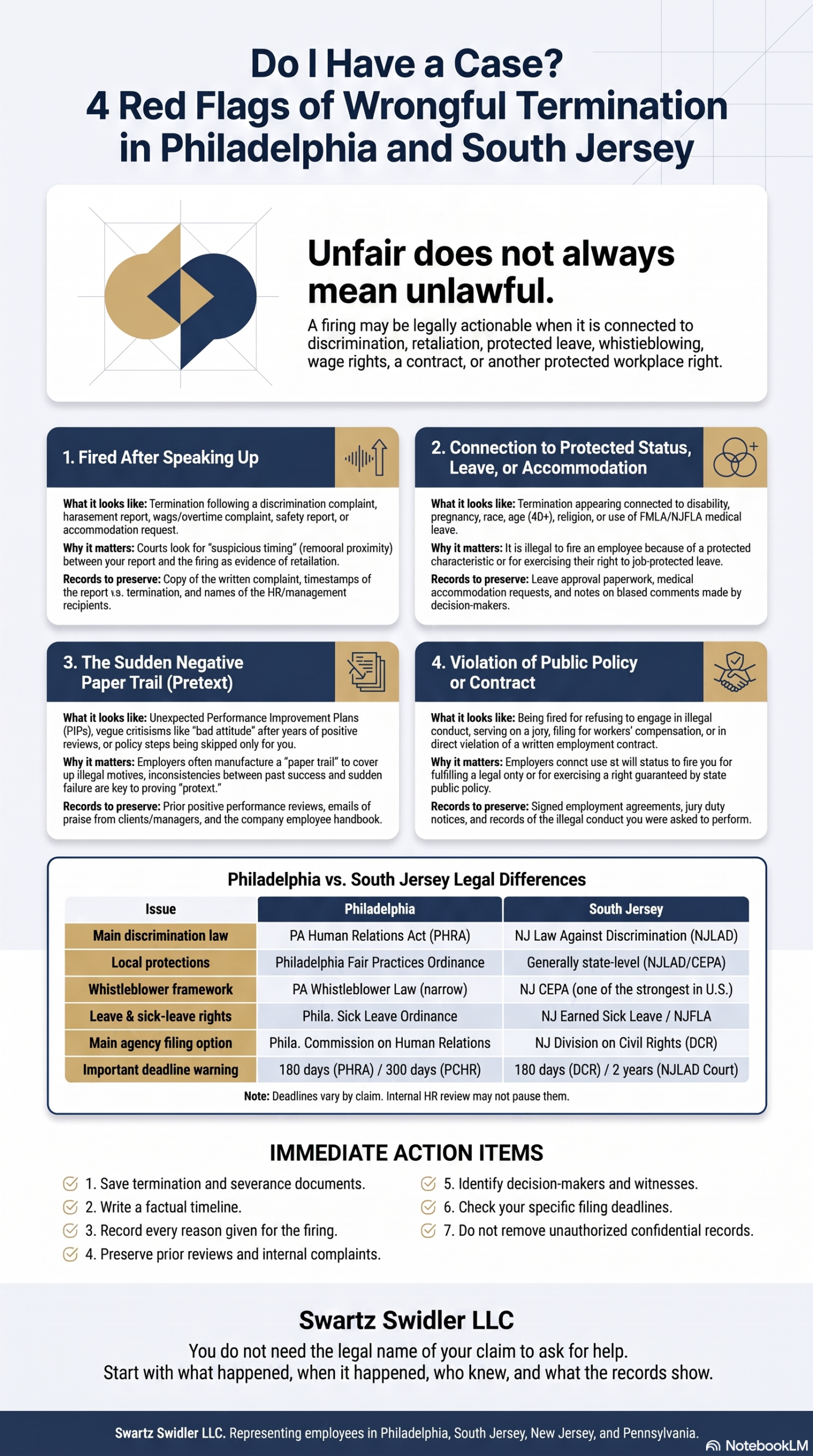
Four important red flags are:
- You were fired shortly after speaking up or exercising a protected workplace right.
- Your protected status, medical leave, pregnancy, disability, or accommodation appears connected to the decision.
- The employer suddenly created a negative paper trail or changed its explanation.
- The firing may have violated a contract, wage or safety protection, whistleblower law, or other public policy.
No single red flag automatically proves a case. The strongest matters usually combine a protected right with evidence showing employer knowledge, suspicious timing, different treatment, contradictory explanations, or departures from normal procedures.
Jurisdiction note: This article provides general information for employees in Philadelphia and South Jersey and is not legal advice. Pennsylvania, Philadelphia, New Jersey, and federal employment laws have different coverage rules, filing procedures, and deadlines. The employee’s actual work location, employer, job duties, agreements, and underlying facts can all affect which law applies.
Four red flags of wrongful termination at a glance
Unfair does not always mean unlawful
Pennsylvania and New Jersey generally follow the at-will employment rule. In an at-will relationship, an employer often may end employment without advance warning, progressive discipline, or a reason the employee considers fair.
That can include decisions based on:
- A personality conflict;
- Favoritism unrelated to a legally protected characteristic;
- A business judgment that turns out to be wrong;
- A minor mistake;
- A manager’s poor judgment;
- A restructuring or reduction in force; or
- A reason the employer chooses not to explain.
Those decisions may be frustrating or unjust. They are not automatically illegal.
At-will employment does not allow an employer to fire someone because of discrimination, retaliation, protected leave, whistleblowing, a wage complaint, a legally protected accommodation request, refusal to violate the law, or another prohibited reason.
A wrongful-termination claim may arise under:
- Federal anti-discrimination or retaliation laws;
- The New Jersey Law Against Discrimination;
- The Pennsylvania Human Relations Act;
- The Philadelphia Fair Practices Ordinance;
- The Family and Medical Leave Act;
- New Jersey or Philadelphia leave laws;
- Federal or state wage laws;
- A whistleblower statute;
- A recognized public-policy exception;
- An enforceable employment contract; or
- A collective bargaining agreement.
Does the employer have to follow progressive discipline?
Not always.
An employer’s handbook may describe verbal warnings, written warnings, performance plans, or other disciplinary steps. Many handbooks also contain language preserving at-will employment and allowing the employer to skip steps.
Failure to follow a policy does not automatically create a wrongful-termination case.
It can still matter when:
- The employer consistently followed the policy for other employees;
- The policy was skipped only after you made a protected complaint;
- Comparable employees received warnings but you were immediately fired;
- The employer later relies on the policy to justify its decision; or
- A written contract or collective bargaining agreement made the procedure binding.
In those circumstances, the policy departure may help show that the employer’s stated reason is not the real reason.
Red Flag 1: You were fired shortly after speaking up
One of the most important questions in a wrongful-termination review is:
What did you report, request, or oppose before the employer fired you?
Protected activity may include a good-faith complaint about:
- Race, sex, age, disability, pregnancy, religious, or other discrimination;
- Sexual harassment or a hostile work environment;
- Retaliation;
- Unpaid wages, overtime, or commissions;
- Workplace safety;
- Fraud or false records;
- Patient-care or licensing concerns;
- Protected medical or family leave;
- A disability or religious accommodation;
- Other conduct prohibited by an applicable workplace law; or
- Participation in an investigation involving another employee.
A complaint may be protected even when HR ultimately concludes that it cannot substantiate the underlying allegation. The employee generally needs to have acted in good faith and under circumstances protected by the applicable law.
Why timing matters
A firing days or weeks after a protected complaint can raise a serious question about motive.
Examples include:
- You reported harassment on Monday and were terminated the following Friday.
- You complained about unpaid overtime and your hours were cut before you were fired.
- You participated in an HR investigation and immediately received your first written warning.
- You reported a safety issue and management began documenting minor mistakes.
- You requested an accommodation and were told the company needed someone “more dependable.”
Timing alone does not automatically prove retaliation.
It becomes more persuasive when combined with:
- Proof that the decision-maker knew about the complaint;
- Comments expressing frustration that you spoke up;
- A sudden change in treatment;
- Increased scrutiny;
- Exclusion from meetings or assignments;
- New discipline;
- Different treatment of coworkers who did not complain;
- Changing explanations; or
- Evidence that termination was not being considered before the complaint.
Timing becomes less persuasive when documents show that the termination decision was made before the protected activity or that serious performance problems were already documented.
Prove who knew
An employer generally cannot retaliate for a complaint that the relevant decision-makers genuinely did not know about.
Preserve evidence showing:
- Who received the complaint;
- Who acknowledged it;
- Who attended HR meetings;
- Who conducted the investigation;
- Who recommended termination;
- Who approved the decision; and
- Whether information was passed from HR to management.
Useful records may include emails, calendar invitations, complaint forms, meeting notes, text messages, witness accounts, and management responses.
For a more detailed proof framework, review Swartz Swidler’s guide on how to prove workplace retaliation.
Philadelphia employees can also review what may happen when an employee is fired after reporting harassment or discrimination in Pennsylvania.
Red Flag 2: Protected status, medical leave, or an accommodation appears connected to the firing
A termination may be discriminatory when the employee’s protected characteristic was a reason for the decision.
Protected categories vary under federal, New Jersey, Pennsylvania, and Philadelphia law. They may include:
- Race or color;
- Sex;
- Pregnancy;
- Sexual orientation;
- Gender identity or expression;
- Religion;
- National origin or ancestry;
- Age;
- Disability;
- Genetic information;
- Marital or familial status under certain laws;
- Military status; and
- Other state- or city-protected characteristics.
The exact categories and employer-size requirements differ. That distinction can be especially important for employees working for small Philadelphia businesses.
Comments and stereotypes
Statements by a manager or decision-maker may help show motive.
Examples may include comments such as:
- “We need younger energy.”
- “Your pregnancy is becoming a scheduling issue.”
- “We need someone who does not have these medical problems.”
- “Your accent makes clients uncomfortable.”
- “You do not fit the culture.”
- “People with your restrictions cannot handle leadership.”
- “You should focus on your family instead of this job.”
Not every rude or insensitive remark proves discrimination. Consider:
- Who made the statement;
- Whether that person influenced the termination;
- How close the comment was to the decision;
- Whether similar comments were repeated;
- Whether the statement relates directly to the employer’s explanation; and
- Whether other evidence supports the same inference.
Write down the exact words, speaker, date, location, context, and witnesses. Do not strengthen or rewrite the comment after the fact.
Comparator evidence
Comparator evidence asks whether similarly situated employees were treated differently.
For example:
- Were employees outside your protected group given warnings for the same conduct?
- Did coworkers with similar attendance records keep their jobs?
- Were younger employees retained during a reduction in force?
- Did employees who did not take leave receive more favorable discipline?
- Were employees who did not complain allowed to correct the same mistake?
A useful comparator often has meaningful similarities involving:
- Job duties;
- Supervisor;
- Performance expectations;
- Disciplinary history;
- Conduct at issue; and
- Decision-making process.
Differences between employees can affect how useful the comparison is.
Termination after FMLA or medical leave
Eligible employees of covered employers may have job-protected leave rights under the federal Family and Medical Leave Act.
Potential warning signs include:
- Termination during approved leave;
- Firing immediately after return;
- Counting protected absences as attendance violations;
- Pressuring the employee to return early;
- Treating a leave request as a voluntary resignation;
- Refusing to return the employee to the same or an equivalent role; or
- Saying the company needs someone “more reliable” because of medical absences.
Protected leave does not make an employee immune from a genuine company-wide layoff, serious misconduct, or a termination decision made for an independent reason.
The question is whether the employer would have made the same decision without the protected leave.
For more information, review Swartz Swidler’s page on FMLA and medical-leave rights.
New Jersey’s July 2026 leave expansion
Beginning July 17, 2026, New Jersey expanded job-protection rules for many workers receiving Temporary Disability Insurance or Family Leave Insurance benefits when the leave is not already covered by the federal FMLA or NJFLA.
New Jersey also broadened NJFLA eligibility by reducing certain employer-size, employment-duration, and hours-worked requirements.
Employees should not assume older online explanations accurately reflect these newer protections.
Philadelphia sick-leave protections
Philadelphia law provides paid or unpaid sick-leave rights to covered employees and prohibits retaliation for exercising those rights.
The city’s 2025 POWER Act strengthened retaliation and enforcement provisions involving paid sick leave, wage theft, domestic-worker protections, and other local worker-protection ordinances.
A termination may deserve closer review when it followed:
- A request to use accrued sick time;
- A complaint that sick time was denied;
- A wage-theft report;
- A complaint involving a local worker-protection ordinance; or
- Participation in a city investigation.
Termination after a disability accommodation request
An employer may not punish an employee merely for requesting a reasonable disability accommodation.
Potential accommodations may include:
- A modified schedule;
- Medical leave;
- Equipment changes;
- Modified duties;
- A policy adjustment;
- Remote work in appropriate circumstances; or
- Another effective workplace change.
The requested accommodation does not have to be approved for retaliation to be a concern. The employer may lawfully deny a particular request in some circumstances, but it cannot fire the employee merely for asking in good faith.
Employees who believe they were treated differently because of disability can review Swartz Swidler’s information about workplace-discrimination claims.
Red Flag 3: The employer suddenly created a negative paper trail
Employers rarely write:
“We fired this employee because they complained.”
Instead, the employer may say:
- Poor performance;
- Bad attitude;
- Attendance;
- Misconduct;
- Restructuring;
- Position elimination;
- Lack of work;
- Failure to meet expectations; or
- Not being a team player.
Those can be legitimate reasons.
The question is whether the explanation is true, consistently applied, and supported by records created before the dispute.
What is pretext?
“Pretext” means the employer’s stated reason may be a cover for an unlawful reason.
Possible signs include:
- Years of positive reviews followed by sudden criticism;
- A performance plan immediately after a complaint or leave request;
- Vague criticisms without examples;
- Goals that appear unrealistic or different from coworkers’ goals;
- No prior warning despite an alleged serious problem;
- Discipline that does not follow the employer’s usual process;
- Coworkers committing the same conduct without termination;
- A position called “eliminated” but quickly refilled;
- Documents created only after protected activity;
- The employer falsely claiming the employee resigned;
- The termination occurring before an investigation is completed; or
- Different reasons given to different audiences.
Shifting explanations
Changing explanations can be especially important.
For example:
- HR says the termination was a layoff.
- The termination letter cites performance.
- The employer tells the unemployment agency it was misconduct.
- The employer later argues that the position was eliminated.
Those differences do not automatically establish illegality. They can create questions about whether the employer is consistently describing the same underlying decision.
Preserve:
- The termination letter;
- Notes from the termination meeting;
- Severance documents;
- HR emails;
- Performance records;
- Unemployment correspondence;
- Replacement job postings; and
- Any later written explanation.
Sudden performance plans
A performance improvement plan is not automatically retaliation. Employers may use PIPs for legitimate performance concerns.
The surrounding sequence matters.
Ask:
- Were the alleged problems documented before the protected activity?
- Are the goals objective and achievable?
- Were comparable employees placed on similar plans?
- Does the plan conflict with recent reviews?
- Was meaningful coaching provided?
- Had management already decided to terminate you?
- Did the employer follow the same process it used for others?
Red Flag 4: The firing may have violated a protected right, public policy, or contract
Some wrongful-termination claims do not begin with discrimination.
They begin with an employee exercising a legal right, fulfilling a public duty, reporting wrongdoing, or refusing to participate in conduct the employee believes is unlawful.
Examples may include firing an employee for:
- Reporting unpaid wages or overtime;
- Cooperating in a wage investigation;
- Reporting serious safety concerns;
- Filing a workers’ compensation claim;
- Serving on a jury;
- Reporting fraud or false records;
- Refusing to falsify information;
- Refusing to participate in unlawful conduct;
- Reporting professional or patient-safety concerns;
- Participating in a government investigation; or
- Exercising another right protected by a specific law.
Not every complaint about workplace unfairness is legally protected. The content of the report, the employee’s belief, the recipient, the employer, and the governing law all matter.
New Jersey whistleblower protections
New Jersey’s Conscientious Employee Protection Act, commonly called CEPA, can protect employees who disclose, object to, or refuse to participate in certain conduct they reasonably believe violates law, regulation, public policy, or professional standards.
CEPA may apply to internal complaints in appropriate circumstances. An employee does not always have to report the issue to a government agency first.
Potential evidence includes:
- The original report;
- The conduct identified;
- The law, rule, safety concern, or professional standard involved;
- The person who received the report;
- Management’s response;
- Changes after the report; and
- The termination decision.
Employees should not assume that every disagreement with management qualifies as whistleblowing.
Review Swartz Swidler’s information about whistleblower-retaliation claims for additional context.
Pennsylvania whistleblower and public-policy claims
Pennsylvania’s statutory Whistleblower Law has different coverage from New Jersey CEPA and is often especially relevant to public employers or publicly funded entities.
Private-sector Pennsylvania employees may need to rely on a specific federal or state statute or Pennsylvania’s narrow public-policy exception.
Public-policy claims are fact-specific and applied cautiously. Possible scenarios can include:
- Filing a workers’ compensation claim;
- Serving on a jury;
- Refusing to commit a crime;
- Performing a legal duty;
- Reporting conduct protected by a specialized statute; or
- Exercising another clearly established public right.
The existence of a public concern or ethical disagreement does not automatically establish a Pennsylvania wrongful-discharge claim.
Wage and overtime retaliation
Federal and state laws may protect employees who complain about:
- Unpaid minimum wages;
- Unpaid overtime;
- Off-the-clock work;
- Illegal deductions;
- Misclassification;
- Unpaid commissions; or
- Other covered wage violations.
An employee may have a retaliation issue when the employer responds to a protected wage complaint by:
- Reducing hours;
- Changing the schedule;
- Demoting the employee;
- Threatening immigration consequences;
- Issuing sudden discipline; or
- Terminating employment.
Employees with wage concerns can review the firm’s information about unpaid wages and overtime.
Employment contracts and collective bargaining agreements
A written employment agreement may require:
- Good cause for termination;
- Advance notice;
- A specific disciplinary process;
- A defined employment term;
- Payment upon termination; or
- Arbitration or another dispute procedure.
Collective bargaining agreements may provide grievance and arbitration rights.
An ordinary employee handbook is not automatically an enforceable contract. The wording, disclaimers, promises, employer conduct, and applicable law matter.
Preserve:
- The signed employment agreement;
- Offer letter;
- Collective bargaining agreement;
- Employee handbook;
- Compensation plan;
- Severance plan;
- Disciplinary policy; and
- Any amendment or acknowledgment.
Philadelphia and South Jersey: What changes when you cross the river?
Living in New Jersey does not automatically mean New Jersey employment law controls a job performed in Philadelphia.
Likewise, working for a Pennsylvania-based company does not automatically prevent New Jersey law from applying to work performed in South Jersey.
The employee’s work location is often important, but cross-border, hybrid, remote, and multi-state employment can require a more detailed analysis.
What evidence should you save after being fired?
Wrongful-termination cases rarely depend on one perfect email.
The evidence usually forms a pattern showing:
- What protected right or characteristic may be involved;
- Who knew about it;
- What changed afterward;
- What reason the employer gave; and
- Why that explanation may not fit the records.
Termination and severance records
Preserve:
- Termination letter;
- Separation notice;
- Severance agreement;
- Deadline communications;
- Final-pay records;
- Benefits and COBRA information;
- Unemployment paperwork;
- Notes from the termination meeting; and
- Every reason the employer gave.
Protected complaints and requests
Save:
- HR complaints;
- Harassment or discrimination reports;
- Accommodation requests;
- FMLA or leave forms;
- Wage complaints;
- Safety reports;
- Workers’ compensation records;
- Whistleblower reports;
- Investigation communications; and
- Management responses.
Performance history
Preserve records created before the dispute:
- Performance reviews;
- Awards;
- Positive emails;
- Sales or productivity reports;
- Promotion discussions;
- Bonus records;
- Attendance history;
- Prior discipline; and
- Objective job results.
Comparator and replacement evidence
Record:
- Names and roles of coworkers who were treated differently;
- Similar conduct they allegedly committed;
- Who supervised them;
- What discipline they received;
- Who replaced you;
- Whether your former job was reposted; and
- Whether your duties continued after the alleged elimination.
Witness information
For each potential witness, write down:
- Name;
- Job title;
- What the person observed;
- Relevant dates;
- Statements heard; and
- Lawfully available contact information.
Do not pressure coworkers to take sides or provide scripted statements.
Your first 72 hours after termination
What to do before records disappear or deadlines begin to close
- Write a factual timeline. Start before the protected event and continue through the termination.
- Record every reason given. Distinguish what HR, your manager, the termination letter, and other records say.
- Save documents you lawfully possess. Preserve termination records, reviews, complaints, pay records, and agreements.
- Identify protected activity. List complaints, leave, accommodations, wage reports, safety reports, or investigations.
- Identify decision-makers. Record who recommended, approved, and communicated the firing.
- List witnesses and comparators. Note what each person may know.
- Apply for unemployment when appropriate. Be accurate about whether you were fired, laid off, or resigned.
- Review severance before signing. A release may waive discrimination, retaliation, wage, leave, whistleblower, and termination claims.
- Calendar possible deadlines. Do not wait for HR, unemployment, or severance discussions to finish.
- Avoid emotional public posts. Social-media statements may complicate the dispute.
Do not take unauthorized confidential records
Evidence preservation has limits.
Do not:
- Access systems after authorization ends;
- Guess or use another person’s password;
- Download an entire customer database;
- Take patient or medical records;
- Copy trade secrets;
- Remove privileged communications;
- Alter records or metadata;
- Destroy unfavorable documents; or
- Secretly copy information you were never authorized to possess.
Misappropriating confidential records can give the employer a separate defense, undermine credibility, and limit potential recovery.
Preserve ordinary employment documents that are already lawfully available to you. Obtain legal advice before taking material that belongs to the employer or concerns customers, patients, clients, or third parties.
Do not secretly record without legal advice
Recording laws differ between Pennsylvania and New Jersey, and workplace recordings can create separate legal or employment issues.
Do not assume that a recording is lawful merely because you participate in the conversation. Obtain jurisdiction-specific advice before secretly recording.
Filing deadlines: Why employees should not wait
Different claims use different filing periods, procedures, and triggering events.
A later HR response, termination appeal, unemployment hearing, or severance negotiation may not extend the original deadline.
Should you sign a severance agreement after being fired?
A severance offer does not prove that the employer acted unlawfully. It also does not mean that you have no potential claim.
A severance agreement commonly requires the employee to release claims involving:
- Discrimination;
- Retaliation;
- Wrongful termination;
- Medical or family leave;
- Wages and commissions;
- Whistleblowing;
- Contract rights; and
- Other employment disputes.
Before signing, review:
- The payment;
- Money already owed;
- The scope of the release;
- Confidentiality;
- Non-disparagement;
- Noncompete or nonsolicitation terms;
- Unemployment language;
- Health insurance;
- No-rehire language;
- Signing and revocation deadlines; and
- The events leading to termination.
Review Swartz Swidler’s guide on what employees should check before signing a severance agreement.
What compensation may be available?
Available remedies depend on the claim, governing law, evidence, mitigation efforts, and actual losses.
Potential remedies may include:
- Back pay;
- Lost benefits;
- Front pay;
- Reinstatement;
- Emotional-distress damages;
- Punitive damages under certain laws and facts;
- Contract damages;
- Statutory damages or penalties;
- Attorneys’ fees and costs under qualifying statutes; and
- Other equitable relief.
No remedy is automatic. Employees also generally have obligations to make reasonable efforts to reduce ongoing wage losses by seeking suitable work.
Related Swartz resources
For the primary service page, review Swartz Swidler’s information for wrongful termination attorneys.
If you are unsure whether the facts may support any employment-law claim, start with questions to ask when deciding whether you have an employment-law case.
For evidence involving complaints, timing, discipline, and shifting explanations, review how to prove workplace retaliation and the firm’s overview of workplace-retaliation rights.
Employees concerned about protected status can review the firm’s page on workplace-discrimination claims.
Employees dealing with medical or family leave can review FMLA and medical-leave rights.
Employees reporting possible fraud, legal violations, or safety concerns can review the firm’s information for whistleblower claims.
To organize your records before speaking with counsel, use Swartz Swidler’s guide on how to prepare for an employment-law consultation.
Frequently asked questions
Does being fired without warning mean I was wrongfully terminated?
No. At-will employers often may terminate employees without advance warning or progressive discipline. The important question is whether the firing violated a law, contract, or recognized public policy.
Can my employer legally fire me for no reason?
Often, yes. At-will employment may permit termination for no stated reason. It does not permit an employer to conceal discrimination, retaliation, protected-leave interference, wage retaliation, whistleblower retaliation, or another illegal motive.
Is an unfair firing the same as wrongful termination?
No. An unfair firing may involve favoritism, inaccurate information, rude treatment, or poor management. A wrongful termination generally violates a specific legal protection.
I was fired shortly after complaining to HR. Is that retaliation?
It may be a red flag, but timing alone does not prove retaliation. Decision-maker knowledge, changed treatment, comments, sudden discipline, shifting explanations, and comparator evidence may strengthen the connection.
What if HR did not agree with my complaint?
A good-faith complaint may still be protected even if HR does not substantiate it. Protection depends on what you reported, what you reasonably believed, and the law involved.
What if I had strong reviews and then received a sudden PIP?
A sudden performance plan may be relevant when it follows protected activity and contradicts prior performance records. A PIP can also be legitimate, so the goals, timing, process, and treatment of comparable employees matter.
Can I be fired while on FMLA leave?
Protected leave does not prevent every lawful termination. An employer cannot fire an eligible employee because the employee requested or used protected FMLA leave. The employer may still act for an independent lawful reason.
Can I be fired after requesting a disability accommodation?
An employer may take legitimate action unrelated to the request, but it cannot fire an employee merely because the employee requested a reasonable accommodation or asserted disability rights.
Can I be fired for reporting unpaid overtime?
Federal and state wage laws may protect employees who make covered wage complaints or participate in wage investigations. The content and circumstances of the complaint matter.
Can I be fired for reporting illegal conduct?
Potentially not. The answer depends on what you reported, your reasonable belief, who received the report, your employer, your work location, and the whistleblower or public-policy law involved.
Does my employer have to follow its progressive-discipline policy?
Not always. A handbook may preserve the employer’s discretion. Selectively skipping the policy may still be evidence that the employer’s explanation is pretextual.
What if coworkers committed the same violation but were not fired?
Their treatment may be relevant if they were similarly situated. Job duties, supervisor, performance history, conduct, and disciplinary standards may affect whether they are useful comparators.
I live in South Jersey but worked in Philadelphia. Which law applies?
Residence alone does not decide the issue. Work location, remote-work arrangements, employer operations, reporting structure, agreements, and where the challenged conduct occurred may all matter.
Should I apply for unemployment?
Apply promptly when appropriate and describe the separation accurately. Preserve the employer’s unemployment response because it may show how the employer characterized the termination.
Should I sign my severance agreement?
Review it first. Signing may waive wrongful-termination, discrimination, retaliation, wage, leave, whistleblower, and contract claims.
Can I download company emails to preserve evidence?
Preserve ordinary employment records you lawfully possess, but do not download proprietary databases, trade secrets, patient files, confidential customer material, privileged communications, or records you were never authorized to take.
Should I secretly record my employer?
Recording laws and workplace consequences differ between Pennsylvania and New Jersey. Obtain jurisdiction-specific legal advice before secretly recording.
How long do I have to file?
It depends on the claim and forum. Some administrative discrimination periods are 180 days, Philadelphia local claims generally use 300 days, NJLAD court actions often use two years, and CEPA generally uses one year. Other claims have different periods.
Do I need to know the exact name of my claim before contacting a lawyer?
No. Start with what happened before the termination, who made the decision, what reason was given, and what documents exist.
Talk with Swartz Swidler about a recent termination
You do not need to identify the exact legal claim before asking for help.
Swartz Swidler represents employees in Philadelphia, South Jersey, New Jersey, and Pennsylvania in wrongful-termination, discrimination, retaliation, whistleblower, wage, medical-leave, accommodation, and severance matters.
An employment lawyer can review what happened before the firing, who knew about any protected activity, the employer’s stated reason, performance records, comparator evidence, severance terms, and filing deadlines.