

Updated June 2026
Yes, your employer may be allowed to request a doctor’s note after you take time off work, but the request must be reasonable, limited, and connected to a legitimate purpose. Employers often ask for medical documentation to verify sick leave, support FMLA leave, evaluate an ADA accommodation request, or confirm that an employee can safely return to work.
But your employer does not have unlimited access to your medical information. In most situations, a doctor’s note should confirm the need for leave, the expected duration of the absence, work restrictions, or fitness to return to work. It usually should not disclose your full medical history, unrelated conditions, or unnecessary diagnosis details.
Direct answer
An employer can request a doctor’s note after time off when the request is tied to sick leave rules, FMLA certification, an ADA accommodation request, or a fitness-for-duty return-to-work requirement. However, the employer’s request should be limited to the information needed. An employer generally should not demand your full medical records, ask for unrelated medical details, or use a doctor’s note request as a pretext for discrimination or retaliation.
If you work in New Jersey, Pennsylvania, Philadelphia, or South Jersey and your employer is demanding excessive medical information, rejecting a valid note, punishing you after medical leave, or refusing to discuss accommodations, you may want to speak with an employment lawyer about your options.
At a glance: When can an employer ask for a doctor’s note?
| Situation | Can a note be required? | What the note should usually cover |
|---|---|---|
| Routine sick leave | Sometimes, depending on state law and employer policy | Dates of absence and confirmation that leave was medically related |
| New Jersey earned sick leave | Generally for three or more consecutive workdays, or certain high-volume dates | Reasonable documentation that sick leave was used for a permitted purpose |
| FMLA leave | Yes, if the employer properly requests medical certification | Medical facts supporting the need for leave, expected duration, and whether the employee cannot perform job duties |
| ADA accommodation request | Yes, if the disability or need for accommodation is not obvious | Documentation of disability-related limitations and the need for accommodation |
| Return after surgery or serious illness | Often yes, if tied to a lawful fitness-for-duty policy | Whether the employee can return and any work restrictions |

Why employers ask for doctor’s notes after time off
Why employers ask for doctor’s notes after time off
Employers ask for doctor’s notes for several reasons. Some reasons are legitimate. Others may be excessive or used improperly. A lawful request usually has a clear connection to attendance, leave administration, workplace safety, job duties, or accommodation needs.
Common reasons include:
- verifying that an absence qualifies for sick leave;
- confirming the need for FMLA leave;
- reviewing an ADA reasonable accommodation request;
- determining whether the employee can safely return to work;
- understanding temporary work restrictions;
- complying with a written attendance or leave policy; or
- administering paid sick leave, short-term disability, or other benefits.
The key question is not simply whether your employer can ask for a note. The better question is: what information is the employer allowed to request, and what is the employer doing with it?
Can my employer ask for a doctor’s note for sick leave?
Sometimes. For ordinary sick leave, whether an employer can request a doctor’s note depends on the employer’s policy and the applicable sick leave law. Many employers have attendance policies requiring documentation after a certain number of consecutive absences.
In New Jersey, earned sick leave rules limit when employers may require documentation. Employers generally cannot require documentation for one day or two consecutive days of earned sick leave. They may require reasonable documentation when an employee uses earned sick leave for three or more consecutive workdays, or when leave is unforeseeable and used during certain high-volume periods or special events identified by the employer.
For Philadelphia employees, local paid sick leave rules may also apply. Philadelphia’s ordinance generally permits reasonable documentation for sick time of more than two consecutive days, and employers should not require documentation that explains the nature of the illness or private medical details beyond what the law allows.
New Jersey sick leave rule to know
For New Jersey earned sick leave, employers generally may request reasonable documentation for three or more consecutive workdays. A request for a doctor’s note after only one day or two consecutive days of protected earned sick leave may be improper unless another lawful policy or legal reason applies.
Can my employer request a doctor’s note for FMLA leave?
Yes. If you request leave under the Family and Medical Leave Act, your employer may request medical certification showing that the leave is for a qualifying serious health condition. FMLA certification is more formal than an ordinary sick-day note.
FMLA medical certification may include information about:
- when the serious health condition began;
- how long the condition is expected to last;
- whether you are unable to perform one or more essential job functions;
- the expected duration of your incapacity;
- whether intermittent or reduced-schedule leave is medically necessary; and
- other appropriate medical facts related to the need for FMLA leave.
Generally, employees must be given at least 15 calendar days to provide FMLA medical certification after the employer requests it. If the certification is incomplete or insufficient, the employer must usually explain in writing what information is missing and give the employee an opportunity to fix it.
FMLA certification usually does not need to include a detailed diagnosis. A health care provider may provide a diagnosis, but under FMLA guidance, the certification generally needs enough medical facts to support the need for leave.
Can my employer require a fitness-for-duty note before I return to work?
Sometimes. After FMLA leave or a serious medical absence, an employer may require a fitness-for-duty certification if the employer has a policy or practice requiring employees in similar jobs with similar conditions to provide one. The employer should notify the employee of the requirement in advance.
A fitness-for-duty note should usually focus on whether you can return to work and perform your job duties. If the employer wants the certification to address your ability to perform essential job functions, the employer should provide notice and identify those essential functions.
A return-to-work note may say things like:
- the employee is cleared to return with no restrictions;
- the employee may return with temporary lifting restrictions;
- the employee needs modified duties for a certain period;
- the employee requires intermittent leave or breaks; or
- the employee cannot safely perform certain duties yet.
If your employer refuses to let you return despite a valid fitness-for-duty note, demands information unrelated to your job, or refuses to discuss restrictions, the issue may involve FMLA interference, disability accommodation, or retaliation.
Can my employer ask for medical documentation for an ADA accommodation?
Yes, in some situations. Under the Americans with Disabilities Act, if your disability or need for accommodation is not obvious, your employer may request reasonable documentation. The purpose is to confirm that you have a disability-related limitation and need an accommodation to perform your job or access a workplace benefit.
However, the request must be limited. In most situations, an employer should not demand your complete medical records. Complete medical records often include unrelated information that has nothing to do with the accommodation request.
For an ADA accommodation request, helpful documentation may explain:
- that you have a medical condition or impairment covered by disability law;
- how the condition limits work-related activities;
- what job tasks are affected;
- what accommodation may help;
- how long the accommodation may be needed; and
- whether restrictions are temporary, recurring, or long-term.
Examples of accommodations connected to medical documentation may include modified schedules, remote work, additional breaks, lifting restrictions, ergonomic equipment, temporary job restructuring, medical leave, modified duties, or reassignment in some circumstances.
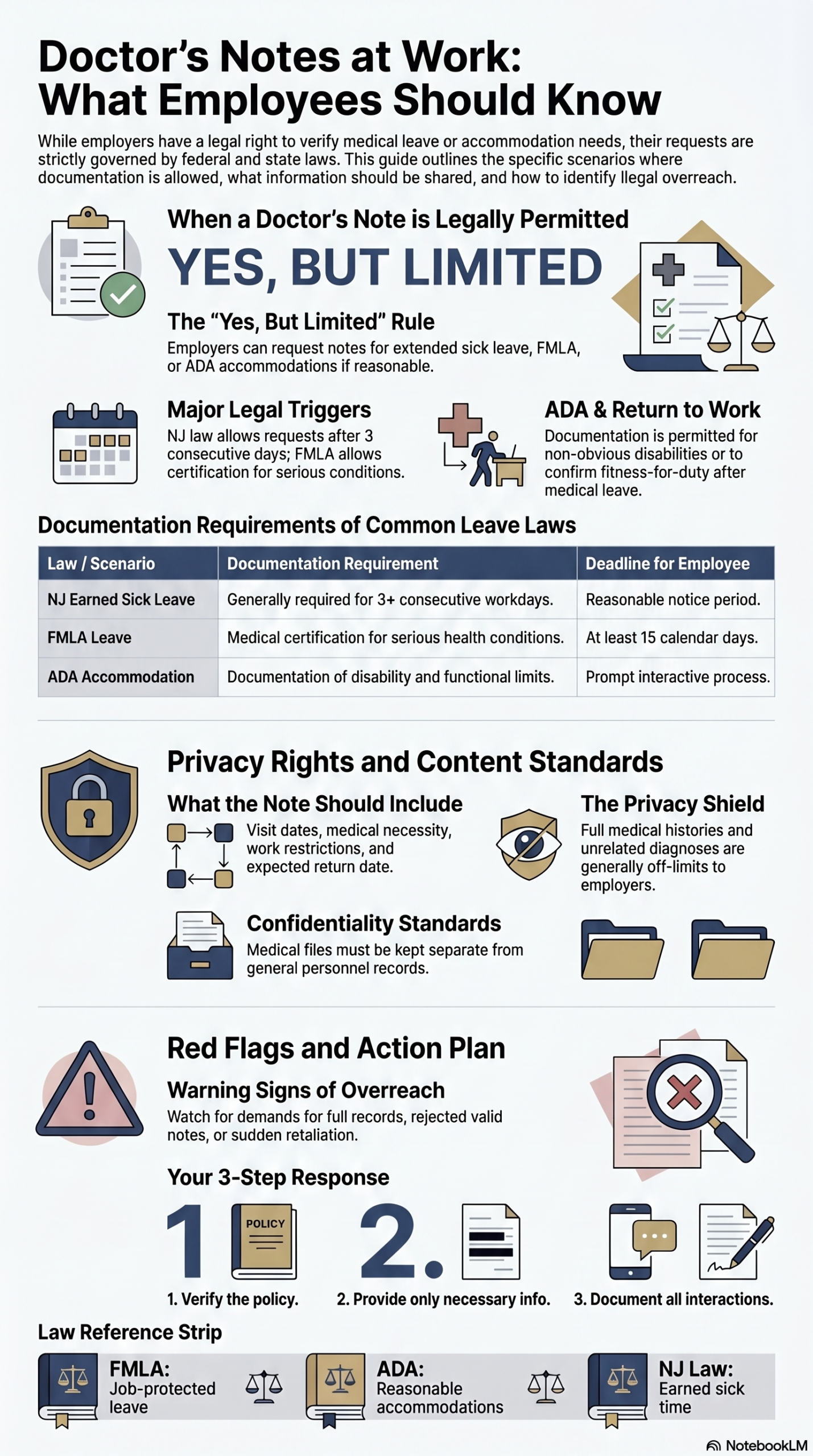
Doctor’s notes at work: when employers may request medical documentation, what privacy limits apply, and what employees should do if a request becomes excessive or retaliatory.
What should a doctor’s note say?
A doctor’s note should be specific enough to address the reason your employer lawfully requested it, but not more detailed than necessary. The right content depends on whether the note is for sick leave, FMLA leave, ADA accommodation, or return-to-work clearance.
A basic doctor’s note may include:
- the date the note was issued;
- the health care provider’s name and contact information;
- the dates you were seen or treated;
- the dates you were unable to work;
- whether leave was medically necessary;
- your expected return date, if known;
- whether you are cleared to return to work;
- temporary or permanent work restrictions, if any; and
- functional limitations relevant to an accommodation request.
A doctor’s note usually should not include:
- your complete medical history;
- unrelated diagnoses;
- private treatment details not needed for leave or accommodation;
- genetic information;
- family medical history unrelated to the request;
- medication details unless truly relevant; or
- information unrelated to your ability to be absent, return to work, or perform your job.
Example of a limited doctor’s note
“Employee was under my care from [date] through [date] and was unable to work during that period for medical reasons. Employee may return to work on [date] with the following restrictions: [restrictions, if any].”
This type of note confirms the medical need and work status without revealing unnecessary private details.
Does HIPAA stop an employer from asking for a doctor’s note?
HIPAA is often misunderstood in workplace medical documentation disputes. HIPAA generally limits how covered health care providers and health plans may disclose protected health information. It usually does not prevent an employer from asking an employee for a doctor’s note when the employer needs information for sick leave, workers’ compensation, health insurance, or leave administration.
However, your medical provider generally cannot give your employer medical information directly without your authorization, unless another law permits or requires the disclosure. Also, even when HIPAA does not apply directly to the employer, other laws may require employers to treat employee medical information as confidential and store it separately from ordinary personnel files.
The practical takeaway is this: your employer may be able to ask you for limited medical documentation, but that does not give the employer a right to your full medical records or unrelated private medical details.
What can my employer ask — and what crosses the line?
Employers may ask for information that is reasonably related to the leave, absence, accommodation, or return-to-work issue. But employers should avoid unnecessary or overly broad requests.
| Usually appropriate | Potentially excessive |
|---|---|
| Dates you were unable to work | Demanding your entire medical file |
| Expected return date | Asking about unrelated medical conditions |
| Whether you can perform essential job functions | Asking coworkers or supervisors to investigate your diagnosis |
| Work restrictions connected to your job duties | Requesting private treatment notes unrelated to work ability |
| Functional limitations for an accommodation request | Using medical information to demote, discipline, isolate, or fire you |
Can an employer reject a doctor’s note?
Sometimes. An employer may question or reject a doctor’s note if the note is incomplete, vague, inconsistent, appears altered, comes from someone who is not an appropriate health care provider for the situation, or does not address the information the employer is lawfully allowed to request.
For example, an employer may ask for clarification if the note says only “patient was sick” but does not provide dates of absence or return-to-work status. In an FMLA situation, the employer may identify what information is missing from an incomplete or insufficient certification and give the employee an opportunity to cure the deficiency.
But an employer should be careful about rejecting a valid medical note without a legitimate reason. If the employer rejects your note and then disciplines, demotes, cuts your hours, refuses to restore your job, or fires you, the issue may involve disability discrimination, FMLA interference, retaliation, or failure to accommodate.
What if your employer asks for a diagnosis?
Whether an employer can ask for diagnosis information depends on the legal context. For ordinary sick leave, employers generally should not need a detailed diagnosis. For New Jersey earned sick leave, employers generally may ask for reasonable documentation in limited circumstances, but they should not require more information than necessary to verify the leave.
For FMLA leave, a medical certification may include appropriate medical facts, and a health care provider may provide a diagnosis, but a diagnosis is not always required. For ADA accommodations, the employer may request enough documentation to establish that you have a disability and need an accommodation, especially if the disability or need is not obvious. That still does not usually justify a demand for complete medical records.
If you are unsure how much information to provide, ask the employer to identify the policy or law supporting the request and ask your health care provider to focus the note on work-related limitations, leave dates, restrictions, and accommodation needs.
Can an employer punish you for taking medical leave or providing a doctor’s note?
No employer should use a doctor’s note request as a reason to punish an employee for exercising workplace rights. Depending on the facts, retaliation may be unlawful under the FMLA, ADA, New Jersey Law Against Discrimination, Pennsylvania Human Relations Act, Philadelphia sick leave protections, or other employment laws.
Possible retaliation may include:
- being fired soon after submitting a doctor’s note;
- being disciplined for protected medical leave;
- having hours, pay, or shifts reduced after requesting leave;
- being demoted or moved to worse assignments;
- being denied restoration after FMLA leave;
- being accused of attendance problems after protected leave;
- being pressured to resign;
- being mocked or singled out because of a medical condition; or
- being denied reasonable accommodations without discussion.
If your employer’s behavior changed after you requested leave, submitted medical documentation, or asked for an accommodation, document the timing. Retaliation cases often depend on the sequence of events and the employer’s stated reason for the adverse action.
You may also want to read Swartz Swidler’s guide on how to prove workplace retaliation.
New Jersey employees: Doctor’s notes, sick leave, and disability rights
New Jersey employees may have several overlapping protections depending on the reason for leave. These may include New Jersey earned sick leave, the New Jersey Law Against Discrimination, the FMLA, the ADA, and employer policies.
Under New Jersey earned sick leave rules, most employees can use earned sick leave for their own illness, a loved one’s illness, preventive care, certain school-related needs, domestic or sexual violence-related reasons, and public health emergency-related reasons. Employers may request documentation only in limited circumstances, such as three or more consecutive workdays or certain high-volume periods.
Under the NJLAD, employees may also have protection from disability discrimination, failure to accommodate, and retaliation. If an employer demands excessive medical information, refuses to discuss reasonable accommodations, or punishes you after medical leave, the facts may require legal review.
Pennsylvania and Philadelphia employees: Doctor’s notes and medical leave
Pennsylvania does not have a statewide paid sick leave law that applies to all private employees. However, Pennsylvania employees may still have rights under employer policies, collective bargaining agreements, the FMLA, the ADA, the Pennsylvania Human Relations Act, and local laws.
Philadelphia has local sick leave protections for many workers. Philadelphia’s paid sick leave rules generally allow an employer to require reasonable documentation for sick time of more than two consecutive days, but the employer should not require the documentation to explain the nature of the illness or private medical details beyond what the law allows.
Because Pennsylvania and Philadelphia rules can depend on employer size, location, job type, and local ordinances, employees should review the specific policy and applicable local law before assuming a doctor’s note request is valid or invalid.
What should you do if your employer asks for a doctor’s note?
If your employer requests medical documentation after time off, you do not have to panic. A doctor’s note request is not automatically unlawful. But you should handle it carefully.
1. Ask what rule or policy applies
Ask whether the request is based on a sick leave policy, FMLA certification, ADA accommodation process, return-to-work policy, collective bargaining agreement, or another rule. Knowing the reason helps determine what information is appropriate.
2. Provide only what is reasonably needed
Your note should answer the legitimate work-related question. For example, it may confirm dates of absence, medical necessity for leave, expected return date, restrictions, or functional limitations. It should not include unrelated medical history.
3. Keep copies of everything
Save the doctor’s note, emails, texts, HR messages, leave forms, accommodation requests, return-to-work notes, and any response from your employer. If your employer later claims you failed to provide documentation, your records will matter.
4. Track deadlines
FMLA certification deadlines are important. Sick leave and accommodation processes may also include deadlines. If your doctor needs more time, tell your employer in writing and document your good-faith efforts.
5. Watch for retaliation
If your employer changes your schedule, reduces your hours, disciplines you, isolates you, pressures you to resign, or fires you after you request leave or provide a note, write down what happened and when.
6. Speak with a lawyer if the request feels excessive or punitive
Legal guidance may be important if your employer is demanding private medical records, rejecting a valid note, refusing to accommodate restrictions, denying FMLA leave, or retaliating after you provide documentation.
Documents to save
- Doctor’s notes and medical certifications
- FMLA forms and designation notices
- Accommodation requests
- Emails or texts with HR or managers
- Attendance policy or sick leave policy
- Return-to-work paperwork
- Work restrictions from your provider
- Schedule changes after the note was submitted
- Disciplinary write-ups
- Termination or resignation documents
- Names of witnesses who saw how you were treated
Red flags that your employer may be overstepping
A doctor’s note request may require closer review if your employer:
- demands your full medical history;
- asks for unrelated diagnoses or treatment details;
- requires documentation for New Jersey earned sick leave when the law does not allow it;
- rejects a doctor’s note without explaining what is missing;
- refuses to give you time to correct an incomplete FMLA certification;
- lets a direct supervisor contact your health care provider about FMLA certification;
- shares your medical information with people who do not need to know;
- disciplines you after you submit medical documentation;
- uses your restrictions as a reason to fire you without discussing accommodations;
- refuses to restore you after protected leave; or
- treats you differently than other employees who took similar leave.
Common examples
Example 1: One sick day in New Jersey
An employee uses one day of New Jersey earned sick leave for illness. The employer demands a doctor’s note before allowing the employee to return. Depending on the facts, that request may conflict with New Jersey earned sick leave rules because documentation generally cannot be required for one day or two consecutive days of earned sick leave.
Example 2: Four consecutive days of sick leave
An employee is out sick for four consecutive workdays. The employer asks for reasonable documentation confirming that sick leave was used for a permitted purpose. That type of request may be allowed, but the employer should not demand unnecessary diagnosis details or full medical records.
Example 3: FMLA leave for surgery
An employee requests FMLA leave for surgery and recovery. The employer provides FMLA paperwork and asks for medical certification. The employee generally has at least 15 calendar days to provide it. The certification should support the need for leave but does not need to disclose unrelated medical history.
Example 4: Return-to-work restrictions
An employee returns after surgery with a note limiting lifting for six weeks. Instead of discussing modified duties, the employer sends the employee home indefinitely. Depending on the facts, the employer may need to consider whether a reasonable accommodation is possible.
Example 5: Retaliation after a doctor’s note
An employee submits a doctor’s note for protected medical leave. Soon after, the employer cuts the employee’s hours and issues a write-up for attendance. If the leave was protected and the timing suggests punishment, the employee may have a retaliation issue.
Frequently asked questions
Can my employer request a doctor’s note after taking time off?
Yes, in some situations. An employer may request a doctor’s note to verify sick leave, support FMLA leave, evaluate an ADA accommodation request, or confirm fitness to return to work. The request should be reasonable and limited to the information needed.
Can my employer ask for my diagnosis?
Usually, an employer does not need a detailed diagnosis for ordinary sick leave. For FMLA leave or ADA accommodation requests, the employer may request medical facts or reasonable documentation, but the request should be limited to the leave or accommodation issue. A demand for full medical records is often excessive.
Does HIPAA prevent my employer from asking for a doctor’s note?
Not usually. HIPAA generally limits what health care providers and health plans may disclose, not what an employer may ask an employee to provide. However, your provider usually cannot give medical information directly to your employer without your authorization, and other employment laws may require confidentiality.
Can my employer require a doctor’s note for one sick day in New Jersey?
For New Jersey earned sick leave, employers generally cannot require documentation for one day or two consecutive days. Documentation may generally be required for three or more consecutive workdays or certain high-volume periods. Other leave laws or employer policies may affect specific situations.
How long do I have to provide FMLA medical certification?
Generally, an employee must be given at least 15 calendar days after the employer’s request to provide FMLA medical certification. If the employee makes diligent, good-faith efforts but cannot meet the deadline, additional time may be required in some circumstances.
Can my employer reject my doctor’s note?
An employer may question a note that is incomplete, vague, inconsistent, or does not address the lawful reason for the request. However, rejecting a valid note without a legitimate reason may raise concerns, especially if the employer then disciplines, fires, or refuses to restore the employee.
Can my boss contact my doctor directly?
For FMLA certification, an employee’s direct supervisor may not contact the health care provider. Certain HR professionals, leave administrators, management officials, or health care providers may contact the provider to authenticate or clarify a certification in limited circumstances. HIPAA authorization issues may also apply.
What should a doctor’s note include?
A doctor’s note should usually include the date, relevant absence period, whether leave was medically necessary, expected return date if known, fitness-for-duty status if returning, and work restrictions if any. For accommodations, it may include functional limitations and the need for accommodation.
Can my employer fire me for taking medical leave?
An employer should not fire an employee for taking protected leave, requesting FMLA leave, using protected sick leave, or seeking a reasonable accommodation. If you were fired after medical leave or after submitting a doctor’s note, the facts may require legal review.
What should I do if my employer is demanding too much medical information?
Ask the employer to identify the policy or law supporting the request. Provide only documentation reasonably related to the leave, accommodation, or return-to-work issue. Keep written records and consider speaking with an employment lawyer if the request is excessive, discriminatory, or retaliatory.
Bottom line
Your employer can request a doctor’s note in some situations, but the request has limits. A lawful request should be tied to sick leave, FMLA certification, ADA accommodation, workplace safety, or return-to-work status. It should not become an excuse to demand private medical records, reject protected leave, deny reasonable accommodations, or retaliate against you.
If your employer is asking for excessive medical information, rejecting your doctor’s note, refusing to let you return to work, or punishing you after medical leave, you should document what happened and get legal guidance before the situation escalates.
Questions about a doctor’s note, medical leave, or retaliation?
If your employer is demanding excessive medical documentation, refusing a valid note, denying accommodations, or retaliating after medical leave, Swartz Swidler can help you understand your rights and next steps.
Submit an employment law claim or call Swartz Swidler at 856.685.7420.
This article is for general informational purposes only and is not legal advice. Doctor’s note, sick leave, FMLA, ADA accommodation, and retaliation issues depend on the facts, the employer’s policy, the applicable law, and the available evidence.