

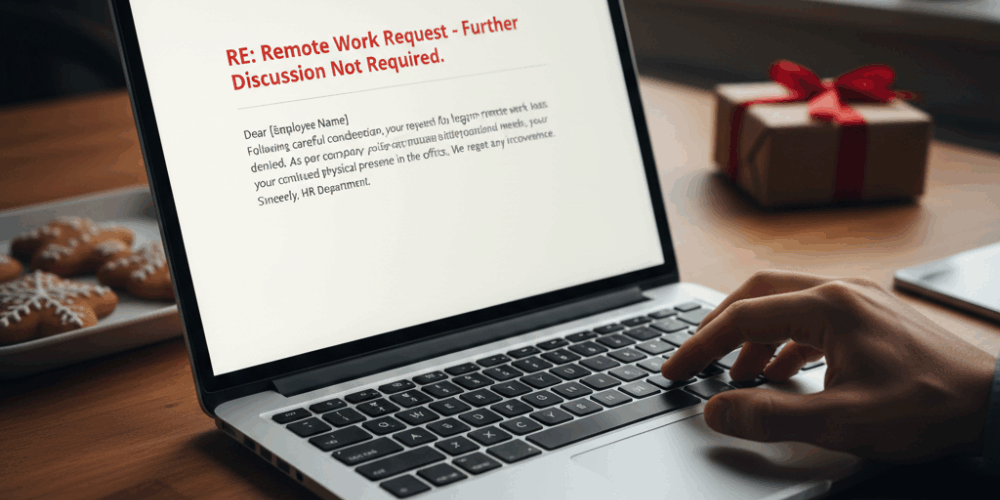
I. The Legal Snapshot: A Quick Summary
While employers generally have the right to set work location policies, they cannot deny a remote work request if it qualifies as a reasonable accommodation under the Americans with Disabilities Act (ADA) or equivalent state laws (NJLAD/PHRA). Denying remote work for discriminatory reasons (e.g., based on disability, gender, or religion) is illegal.
II. Introduction: The Clash Between Policy and Personal Need
The holidays bring a unique mix of family commitments, travel plans, and school breaks. It is natural to seek flexibility, and for many, that means requesting to work remotely. However, this desire often bumps up against “all-hands-on-deck” office policies.
For most employees, an employer’s denial of a remote work request is legal due to at-will employment. Employers can set terms and conditions of employment, and generally, that includes the work location.
However, there are critical exceptions where an employer’s denial crosses the line from being merely unfair to being illegal discrimination. The legal team at Swartz Swidler helps employees distinguish between these two scenarios, especially when a denial is made during sensitive times, like the holidays. If your request was denied, here are the three scenarios where that denial may violate your rights in New Jersey or Pennsylvania.
III. Scenario 1: The Request is a Reasonable Accommodation
The strongest legal grounds for demanding remote work is when the arrangement is necessary due to a qualifying medical condition or disability.
Disability and the ADA/NJLAD
If your request for remote work is due to a qualifying physical or mental disability (such as severe anxiety, a chronic illness, or mobility issues), the federal ADA and state laws like the New Jersey Law Against Discrimination (NJLAD) and the Pennsylvania Human Relations Act (PHRA) require your employer to consider it.
-
The Standard: Remote work must be provided as a reasonable accommodation unless the employer can demonstrate that it creates an undue hardship on the business. You can learn more about this standard here: What is reasonable accommodation?
-
The Interactive Process: Your employer cannot simply reject the request. They must engage in a good-faith interactive process with you to determine if the arrangement is feasible, potentially discussing alternative solutions.
The key for you to demonstrate is that remote work is a medically necessary accommodation, not merely a personal preference.
IV. Scenario 2: Denial is Based on Illegal Discrimination
Even if the request isn’t directly tied to a disability, a denial that is selectively applied to a protected class can constitute illegal discrimination.
-
Gender/Caregiver Discrimination: A denial may become a form of gender discrimination if the employer disproportionately grants remote work flexibility to men but denies it to a female employee who needs it for caregiving responsibilities during the holidays (such as childcare or caring for an elderly parent). If the denial is based on illegal criteria, you may have a case for workplace discrimination [https://swartz-legal.com/do-i-have-a-case-for-workplace-discrimination/].
-
Religious Accommodation: If denying the ability to work remotely prevents you from observing a religious holiday or obligation—or if a manager denies it with a discriminatory motive related to your religion—the employer may be required to provide a religious accommodation.
-
The Comparators Test: If you were denied a request that was granted to a similarly situated colleague who is not a member of your protected class, this comparison can be powerful evidence of differential treatment.
V. Scenario 3: Retaliation for Past Complaints
A denial of a remote work request can be illegal even if the request itself is not legally protected, provided the denial is an act of retaliation.
-
Definition: Retaliation occurs when an employer takes an adverse action against an employee for engaging in protected activity. Protected activity includes reporting sexual harassment, filing a wage claim, or reporting illegal activity as a whistleblower.
-
The Timing is Key: If you reported a hostile work environment or illegal wage practices a month ago, and your remote work request is denied immediately afterward with a vague or pretextual reason, the timing strongly suggests the denial is an act of illegal retaliation. You can learn how to fight this illegal action here: Retaliation in the Workplace: What It Is and How to Fight It.
VI. Next Steps: When the Employer Says No
If your remote work request was denied and you suspect discrimination or retaliation, follow these steps:
-
Document the Denial: Get the employer’s reason for the denial in writing. Scrutinize their stated reason; is it a legitimate business need, or is it vague (e.g., “business need”)?
-
Document the Hardship: If the request was for an accommodation, document how the denial creates a significant challenge or worsens your medical condition.
-
The Crucial Step: An attorney must review the facts to determine if a denial constitutes illegal disability discrimination or retaliation. The legal team at Swartz Swidler can help you evaluate your case and guide you through the appropriate legal process.
VII. Conclusion & Strong Call-to-Action
While an employer holds significant power in the workplace, that power is limited by federal and state discrimination laws. If your necessary holiday remote work request was denied and you believe it was discriminatory or retaliatory, don’t wait.
Contact Swartz Swidler today for a free, confidential consultation to enforce your rights in New Jersey or Pennsylvania.


