

Updated June 2026
If you are successful in an age discrimination claim, the damages you may be able to collect depend on the law that applies, the financial losses you suffered, the strength of the evidence, whether the discrimination was willful, and whether the claim is brought under federal, New Jersey, or Pennsylvania law.
Age discrimination damages may include lost wages, lost benefits, front pay, reinstatement, attorney’s fees, litigation costs, and, in some cases, liquidated damages, emotional distress damages, or punitive damages. The available remedies can differ significantly depending on whether the claim is brought under the federal Age Discrimination in Employment Act, the New Jersey Law Against Discrimination, or the Pennsylvania Human Relations Act.
Swartz Swidler represents employees in New Jersey, Pennsylvania, Philadelphia, and South Jersey in age discrimination, workplace discrimination, retaliation, wrongful termination, severance agreement review, and related employment law matters.
Direct Answer
Age discrimination damages may include back pay, front pay, lost benefits, reinstatement, attorney’s fees, and litigation costs. Under the federal ADEA, successful employees may also recover liquidated damages in certain willful age discrimination cases, but compensatory damages for emotional distress and punitive damages are not available under the ADEA. State law may allow different or broader remedies, especially in New Jersey under the Law Against Discrimination.
Questions about age discrimination damages? Call Swartz Swidler at 856.685.7420 or submit an employment law claim online.
Age Discrimination Damages at a Glance
| Type of damage | What it may cover | Important note |
|---|---|---|
| Back pay | Wages you lost because of termination, demotion, reduced hours, denied promotion, or other discriminatory action. | You may need to show job search efforts and mitigation. |
| Front pay | Future wage losses if reinstatement is not practical or appropriate. | The amount depends on expected future losses and the facts of the case. |
| Lost benefits | Health insurance, retirement contributions, bonuses, commissions, PTO, stock options, or other employment benefits. | Benefit losses should be documented with pay records, plan documents, and benefit statements. |
| Liquidated damages | An additional amount that may be available in certain willful ADEA cases. | Under the ADEA, liquidated damages may equal the back pay award in willful cases. |
| Emotional distress | Emotional harm, humiliation, anxiety, stress, or related personal harm. | Not available under the federal ADEA, but may be available under some state-law claims. |
| Punitive damages | Damages meant to punish especially wrongful conduct. | Not available under the ADEA, but may be available in certain New Jersey LAD cases. |
| Attorney’s fees and costs | Legal fees, court costs, expert fees, and litigation expenses. | Availability depends on the claim and outcome. |
What Laws Apply to Age Discrimination Damages?
What Laws Apply to Age Discrimination Damages?
Age discrimination may be prohibited under federal law and under state law in New Jersey and Pennsylvania. The law that applies can affect what damages are available.
Federal Age Discrimination in Employment Act
The federal Age Discrimination in Employment Act, often called the ADEA, generally protects employees and job applicants who are age 40 or older. The ADEA applies to covered employers and prohibits age discrimination in hiring, firing, promotion, layoff, pay, benefits, job assignments, training, and other terms or conditions of employment.
Under the ADEA, available remedies may include lost wages, lost benefits, reinstatement or front pay, attorney’s fees, and liquidated damages in certain willful cases. However, emotional distress damages and punitive damages are not available under the ADEA.
If you were fired, demoted, selected for layoff, denied promotion, or pushed out because of age, review Swartz Swidler’s page for age discrimination attorneys.
New Jersey Law Against Discrimination
The New Jersey Law Against Discrimination, often called the NJLAD, prohibits age discrimination in employment. New Jersey law can be especially important because it may provide broader remedies than the federal ADEA in certain cases.
New Jersey age discrimination claims may involve:
- termination because of age;
- layoff selection based on age or stereotypes about older workers;
- promotion denials;
- age-based comments about retirement, energy, salary, or technology;
- being replaced by a younger worker;
- unequal discipline compared with younger employees;
- pressure to retire;
- severance agreements that ask older workers to release claims; or
- retaliation after reporting age discrimination.
Under New Jersey law, remedies may include money damages, emotional distress damages, attorney’s fees, equitable relief, and, in some cases, punitive damages. The exact remedies depend on the facts and forum.
Pennsylvania Human Relations Act
The Pennsylvania Human Relations Act, often called the PHRA, protects Pennsylvania employees age 40 and older from employment discrimination. It applies to many Pennsylvania employers and can cover hiring, firing, pay, demotion, discipline, harassment, and retaliation based on age.
If you work in Pennsylvania or Philadelphia, your claim may involve both federal age discrimination law and Pennsylvania state law. The available damages and procedures may differ depending on where the claim is filed and which laws apply.
Back Pay in an Age Discrimination Case
Back pay is one of the most common damages in an age discrimination case. It is meant to compensate an employee for income lost because of discrimination.
Back pay may include:
- wages lost after termination;
- pay difference after a demotion;
- lost overtime opportunities;
- lost commissions or bonuses;
- lost pay from a denied promotion;
- lost benefits connected to employment; and
- other compensation the employee would have earned if discrimination had not occurred.
Employees generally have a duty to mitigate damages. That means you may need to show that you made reasonable efforts to find comparable employment after losing your job or suffering reduced earnings.
Front Pay and Reinstatement
In some cases, reinstatement may be available. Reinstatement means returning the employee to the job or a comparable position. But reinstatement is not always practical, especially when the relationship has broken down, the position no longer exists, or returning to work would be unrealistic.
When reinstatement is not appropriate, front pay may be considered. Front pay is compensation for future lost earnings caused by the discrimination. The amount depends on the facts, including the employee’s age, job history, expected earnings, job search, likelihood of finding comparable work, and how long the losses are expected to continue.
Lost Benefits, Retirement, and Other Compensation
Age discrimination damages may include more than base salary. Older workers may lose valuable benefits when discrimination causes termination, demotion, forced retirement, or layoff.
Lost benefits may include:
- health insurance;
- employer retirement contributions;
- 401(k) matching contributions;
- pension-related benefits;
- stock options or equity;
- bonuses;
- commissions;
- paid time off;
- life insurance or disability insurance benefits;
- expense reimbursements; and
- other compensation connected to employment.
If the case involves a severance agreement or release of claims, review Swartz Swidler’s guide to what employees should know about severance packages.
Liquidated Damages Under the ADEA
In federal age discrimination cases under the ADEA, liquidated damages may be available when the employee proves that the employer’s violation was willful. Liquidated damages are not the same as emotional distress damages or punitive damages.
In a willful ADEA case, liquidated damages may equal the amount of back pay awarded. This can be important in cases where the evidence shows the employer knew or recklessly disregarded whether its conduct violated the law.
Examples of evidence that may support willfulness can include age-based comments, ignored warnings, inconsistent explanations, repeated age-based decisions, or documentation showing that age was considered in the employment decision.
Can You Recover Emotional Distress Damages?
It depends on the law that applies. Emotional distress damages are not available under the federal ADEA. However, they may be available under state-law claims, including certain claims under the New Jersey Law Against Discrimination and potentially other state-law claims depending on the facts.
Emotional distress damages may relate to harm such as anxiety, humiliation, depression, sleep disruption, loss of enjoyment, stress, or other emotional effects caused by discrimination. The strength of an emotional distress claim often depends on testimony, medical or counseling records, witness observations, and how the discrimination affected the employee’s life.
Can You Recover Punitive Damages?
Punitive damages are not available under the federal ADEA. In New Jersey, punitive damages may be available in certain LAD cases involving especially wrongful conduct, depending on the facts and proof. Punitive damages are not automatic, and they require a higher showing than ordinary economic loss.
If you are comparing potential federal, New Jersey, and Pennsylvania claims, legal guidance can help determine which laws may apply and what remedies may be available.
What If You Were Offered Severance?
Age discrimination cases often overlap with severance agreements, especially during layoffs, restructurings, forced retirement, or reductions in force. A severance agreement may require the employee to release age discrimination claims in exchange for payment.
If you are age 40 or older, the Older Workers Benefit Protection Act may apply to certain releases of age discrimination claims. Depending on the situation, a valid release may require specific language, time to consider the agreement, written advice to consult an attorney, and a revocation period after signing. Group termination or layoff situations may require additional disclosures.
Before signing, review Swartz Swidler’s guide to the Older Workers Benefit Protection Act and the firm’s page on severance agreement review.
What Evidence Helps Prove Age Discrimination Damages?
The damages in an age discrimination case depend on both liability and proof of loss. You need evidence showing what happened and evidence showing how the discrimination harmed you financially, professionally, or emotionally.
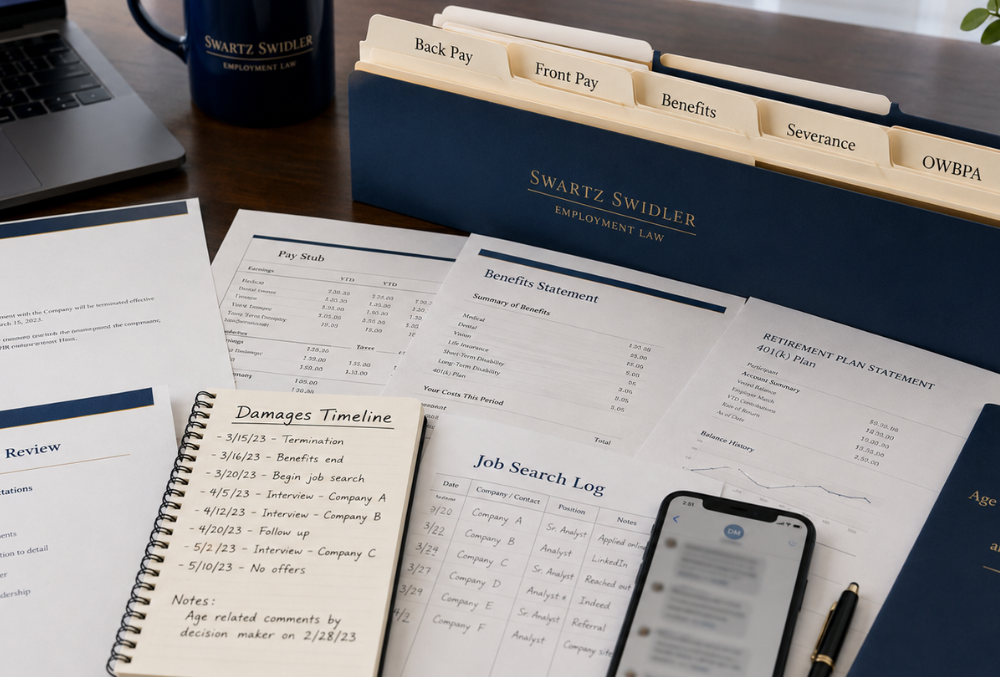
Evidence to save in an age discrimination damages case
- Termination letter, layoff notice, demotion notice, or severance agreement
- Emails, texts, messages, or notes showing age-related comments
- Performance reviews before and after the age-related issue
- Pay stubs, W-2s, bonus records, commission records, and benefits statements
- Retirement plan, pension, 401(k), stock option, or equity documents
- Job postings, replacement information, restructuring documents, or layoff selection criteria
- Names and ages, if known, of employees selected and not selected for layoff
- Records showing younger employees were treated more favorably
- Job search records, applications, interviews, rejection emails, and offer letters
- Medical or counseling records if emotional distress is part of a state-law claim
- Unemployment documents and employer responses
- A timeline showing what happened before and after the discriminatory act
How Mitigation Affects Age Discrimination Damages
If you are seeking lost wages, you should expect the employer to ask what you did to reduce your losses. This is called mitigation. Employees generally need to make reasonable efforts to find comparable work after losing a job or income because of discrimination.
Helpful mitigation records may include:
- job applications;
- cover letters and resumes;
- emails from recruiters;
- interview invitations;
- job search spreadsheets;
- rejection notices;
- new job offers;
- records of lower pay at replacement employment; and
- documents showing efforts to find comparable work.
New Jersey’s Division on Civil Rights specifically notes that employees seeking lost wages should be prepared to show job search efforts and should keep records of their job search while unemployed or earning less than they would have earned without discrimination.
Age Discrimination Damages Are Not One-Size-Fits-All
There is no reliable online calculator for age discrimination damages. Two employees with similar claims may have very different potential recoveries because damages depend on the facts.
Factors that may affect damages include:
- how much income was lost;
- whether the employee found comparable work;
- the employee’s job search efforts;
- lost benefits and retirement value;
- whether the conduct was willful;
- whether state law allows broader remedies;
- the strength of the age discrimination evidence;
- whether the employer gave shifting explanations;
- whether the employee was replaced by a younger worker;
- whether there are age-related comments or documents;
- whether the employee signed a severance agreement or release;
- whether retaliation occurred after a complaint; and
- whether reinstatement or front pay is realistic.
What Should You Do If You Suspect Age Discrimination?
1. Save the documents
Keep termination letters, layoff notices, severance agreements, emails, pay records, performance reviews, and benefits documents.
2. Write down age-related comments
Record who made the comment, what was said, when it happened, who heard it, and how it related to the employment decision.
3. Track replacement or layoff information
If younger employees were kept, promoted, or hired while older employees were selected for termination, that information may matter.
4. Keep job search records
Save job applications, interviews, recruiter emails, and rejection notices. These records may help prove mitigation.
5. Be careful before signing severance
A severance agreement may release age discrimination claims. If you are 40 or older, special older-worker release rules may apply.
6. Speak with an employment lawyer
Age discrimination damages depend on the applicable law, evidence, losses, deadlines, and whether the employer’s explanation can be challenged.
Frequently Asked Questions About Age Discrimination Damages
What damages can I collect in an age discrimination case?
Possible damages may include back pay, front pay, lost benefits, reinstatement, attorney’s fees, costs, liquidated damages in certain federal ADEA cases, and broader state-law damages depending on the facts and applicable law.
Can I recover emotional distress damages for age discrimination?
Not under the federal ADEA. Emotional distress damages may be available under some state-law claims, including certain New Jersey Law Against Discrimination claims, depending on the facts.
Can I recover punitive damages for age discrimination?
Punitive damages are not available under the federal ADEA. They may be available in certain New Jersey LAD cases involving especially wrongful conduct, depending on the facts and proof.
What are liquidated damages in an age discrimination case?
Liquidated damages under the ADEA may be available in certain willful age discrimination cases. In those cases, the liquidated damages amount may equal the back pay award.
Can I get my job back after age discrimination?
Possibly. Reinstatement may be available in some cases. If reinstatement is not practical, front pay may be considered instead.
Does severance affect an age discrimination claim?
It can. A severance agreement may ask you to release age discrimination claims. Employees age 40 or older should review whether the agreement complies with older-worker release rules before signing.
Do I need to look for another job after age discrimination?
If you are claiming lost wages, you generally should keep records showing reasonable job search efforts. Employers often argue that damages should be reduced if the employee did not try to mitigate losses.
How much is an age discrimination case worth?
There is no single formula. The value depends on lost wages, lost benefits, future losses, emotional harm where available, liquidated damages where applicable, evidence strength, mitigation, jurisdiction, and the risks of the case.
Talk to an Age Discrimination Lawyer About Damages
If you believe age discrimination caused you to lose your job, income, benefits, promotion opportunities, retirement value, or emotional well-being, Swartz Swidler can help you understand what damages may be available and what evidence may matter.
Were you harmed by age discrimination at work?
If you were fired, demoted, pushed out, selected for layoff, denied promotion, pressured to retire, or offered severance after age-related treatment, Swartz Swidler can help you understand your options.
Submit an employment law claim or call Swartz Swidler at 856.685.7420.
Related Age Discrimination and Employee Rights Resources
This page is for general informational purposes only and is not legal advice. Age discrimination damages, back pay, front pay, liquidated damages, emotional distress, punitive damages, attorney’s fees, severance releases, and related claims depend on the facts, evidence, applicable law, employer size, filing deadlines, mitigation, and where the claim is filed.